
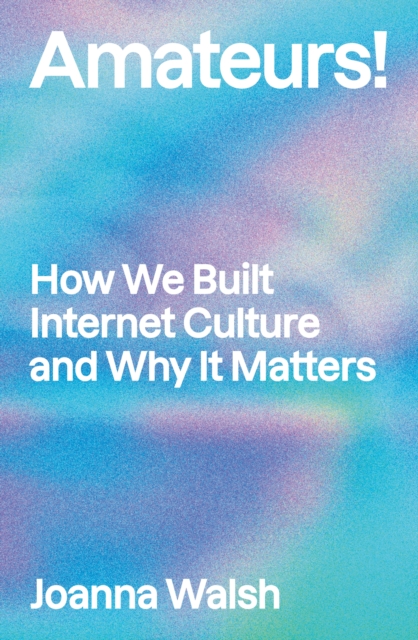
Joanna Walsh’s Amateurs!: How We Built Internet Culture and Why it Matters (Verso, 2025) offers a radical history of the digital world as told from its creative center: the platforms, message boards, servers, and dead links where the internet's earliest amateurs gathered to make and be made by the web. Drawing on theory, philosophy, personal narrative, and stories of early internet ephemera, Amateurs! traces the increasingly porous boundary between amateurism and professionalism in digital space, probing the collaborative origins of the internet and the forces of commodification that refract it.
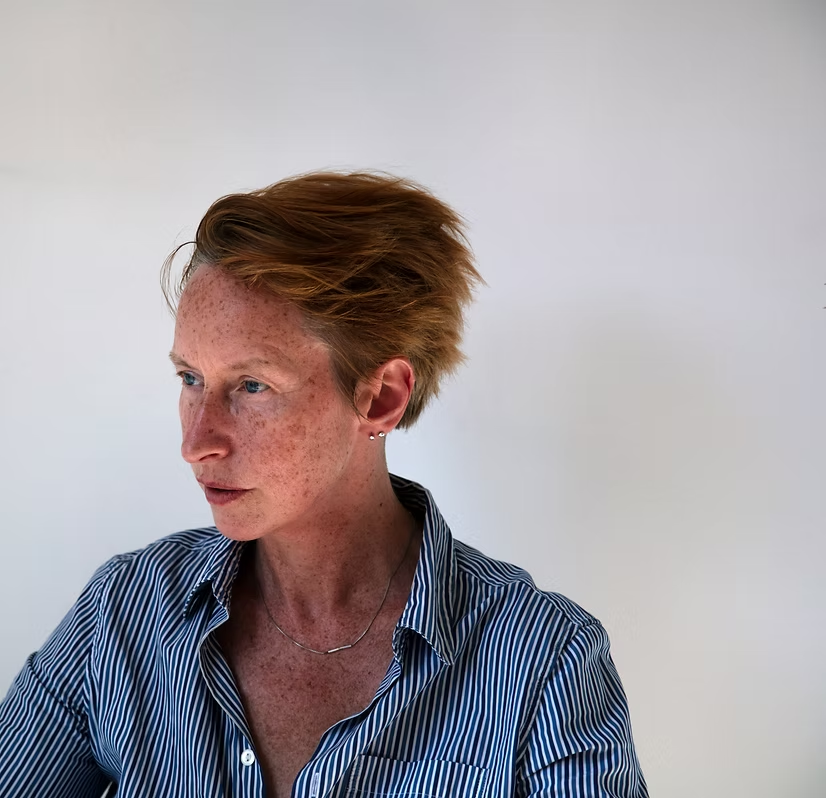
Walsh is a multidisciplinary writer based in Dublin. She is the author of thirteen books, including Girl Online: A User Manual (Verso, 2022)and Break.up: A Novel in Essays (Semiotext(e), 2018)
We spoke via email about online anarchy, commodified girlhood, citation, LOLCats, and the idea of being unsellable.
***
Olivia Q. Pintair: You write about the blurry and osmotic boundary between “amateurs” and “professionals” in digital space, referencing the “temporary autonomous zones” where “pros turn am, and ams go pro, online.” I was struck by this explicit linguistic nod toward anarchist possibility on the web. What do you feel are the political stakes of emphasizing malleability in cyberspace now, amid our current media monopolies, digital surveillance, and increasing pressures to appear online as a fixed and optimized self?
Joanna Walsh I used that reference knowingly. The writings of the anarchist who coined that phrase have been discredited by his advocacy for some of the more harmful ideas on the anarchist spectrum (in Wilson/Bey’s case, paedophilia). Likewise the anarchism that seemed characteristic of the early web has often forked into either libertarianism or profiteering. The internet has been, and has been characterised as, both a place of ‘anarchy’ and control but the net is a tool, not an intention. I’m disturbed by thinking that characterises ‘technology’ as either ‘good’ or ‘bad’ in itself, as this deflects responsibility from the humans who are running the show. I guess I’m saying the medium is not always the message though, as a series of airless spaces controlled by an increasingly limited number of profit-driven organisations, the internet does have the opportunity to control our self-expression, not only most obviously via content control (a.k.a. free speech), but insidiously and powerfully, through aesthetics.
OQP: You’ve written extensively about objectification and commodification in digital space. In your 2022 book Girl Online: A User Manual, you talk about how women are coerced into commodifying our bodies and selves online according to heavily policed social codes. In Amateurs!, you write that to appear digitally requires the creation of an aesthetic, which becomes a kind of currency. Do you think it’s possible to exist online (or in general) as unsellable? What could that look like, if so?
JW: Most platforms ask us to literally reify ourselves, to become a collection of pixels——an avatar, a writing style——that, once recognisable, becomes exchangeable, chargable, piratable. But my experience of pre-internet life was one of inescapable and enforced class, national and gender identities that were far more difficult to escape. At least, online, you can stage your selfies, change your avatar, start a new profile——though the increasing call to back up your identity with government documents limits this: I recently lost my very old ebay account because the version of my name that I’d used for 20 years was not exactly the same as the name on my passport. A call to become ‘unsellable’ is interesting because the creation of a net where participation is unmonetized and purely creative may depend less on the platform change and more on a population that isn’t forced to make money (or social capital) out of what they do online. So we’re not talking about online digital redistribution but offline economic distribution.
OQP: This text spirals through extensive research and references, often reading like a microcosm of the net itself in its citational expansiveness. You draw on the work of writers, theorists, philosophers, critics, psychoanalysts, web designers, and many other anonymous and named online creators. How did you approach research for this book? What is your creative process like in terms of citation?
JW: I can only say by hyperlinking, which is an internet-native technique. I presented some of my work in progress at the university that supported writing this book. One of my senior colleagues was a bit flummoxed by my mix of contemporary and historical theorists, and my use of ‘amateur’ material not only as a subject of critique but as an equal critical approach. Given the internet's flattening effect, why not, rather than using this theory to read what’s happening now, use what's happening now to give a new reading of those theorists? I think a lot about the horizontality of the web. I see this horizontality taken for granted in generations that have grown up internet-native. I know young people——in their teens and twenties——who are experts in film or music picked eclectically across eras due to the availability of internet archives (legit and pirated). I remember trying to educate myself in film in my teens. Their breadth of knowledge is something I (who grew up renting videos from a narrow choice of what was available in the local hire store) could only have dreamt of.
OQP: I hear a lot of subliminal discourse about whether the internet can be considered a part of “nature” or not. I think the assumption is often that humans and our technologies are somehow separate from other forms of earthly evolution, although often, this debate feels like a mask for a larger conversation about humanity's hierarchical relationship with the earth. I’m curious about your thoughts on this, as someone who writes about the web’s collaborative origins.
JW: I haven’t heard this, and tbh I don’t pay a great deal of attention to assertions of a divide between ‘nature’ and ‘everything else’, especially ‘technology’. Maybe I should but, while it can be interesting to think about why people want to invest in this divide, it can be painful and counterproductive to pay too much attention to these constructed divisions, which tend to be easily invoked in repressive arguments——for instance against vaccines and abortion. To respond often requires accepting to some extent the terms of the hierarchy/division proposed, which I’m not willing to do. Why not spend limited time and energy looking into less kneejerk, more subtle and practically useful ways of looking at the way human actions affect and are affected by their environment?
OQP: Any particular amateur internet projects you’ve come across that you’re excited about right now?
JW: It’s getting harder and harder to find 100% amateur projects online. The internet litmags that gave me a start (3am, Necessary Fiction, Minor Lits) are still there but embattled. I was recently talking to Tobias Ryan, who runs Minor Lits after its founder, Fernando Sdrigotti, stepped down. With the decline of Twitter, he told me, the magazine has lost a lot of its reach. It has an account on Bsky but Toby says people will like its posts but rarely click thru. This is also my experience with Bsky, sadly: I get a lot of new followers but so many of them just seem to be following as many people as possible in order to collect return follows, and have no interest in engaging. I got on Twitter in the late 2000s exactly because I could engage with people who’d previously seemed impossibly out of reach. Talking to writers there gave me an education in reading and writing, and made me start to think maybe I could do this myself. Social media is now less social: it’s another form of work. I used to share personal stuff on socials and I admire people who can still post their nice dinner or dog walk. Motivations might be complex here——few people are above hoping for a few more followers/to generate a bit of FOMO/to get respect as an interesting/creative/righteous person——but it still stands as a form of resistance against the commodification of everything. I’m sad that I just can’t do it any more. But I think I found my favourite current amateur project by answering the next question.
OQP: Do you have a favorite LOLCat meme?
JW: haha, Jorts was kind of funny for a while. But wait! I was (as they used to say online) ‘today years old’ when I found out that Jorts has become a pro-union activist in the US, and his (and Jean’s) Twitter account calls out unfair practice at companies including Starbucks, while disseminating information about labor rights and on how to unionise. I wish I’d known about that when I wrote my LOLCats chapter, which is all about memes, work, and resistance.