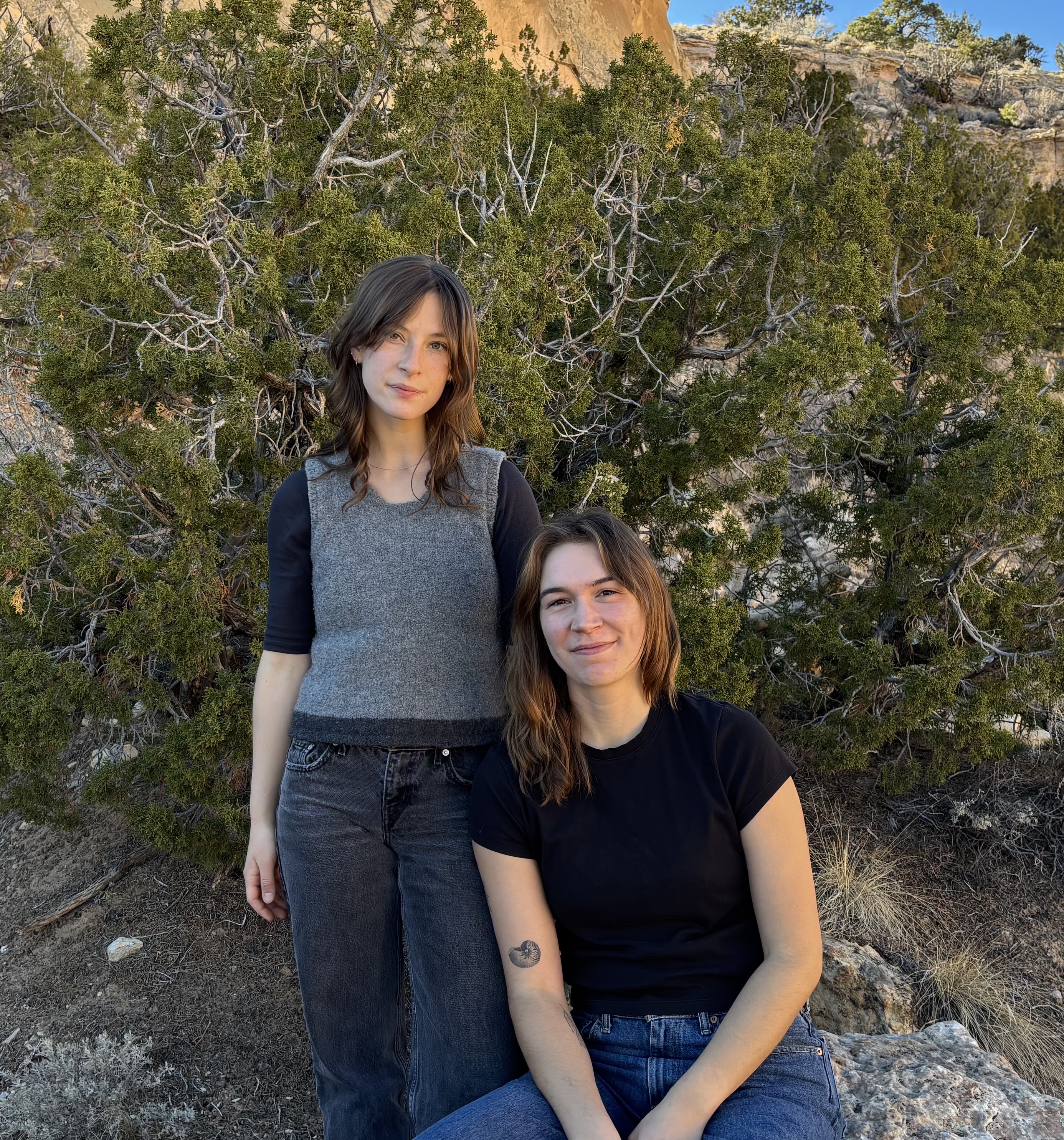
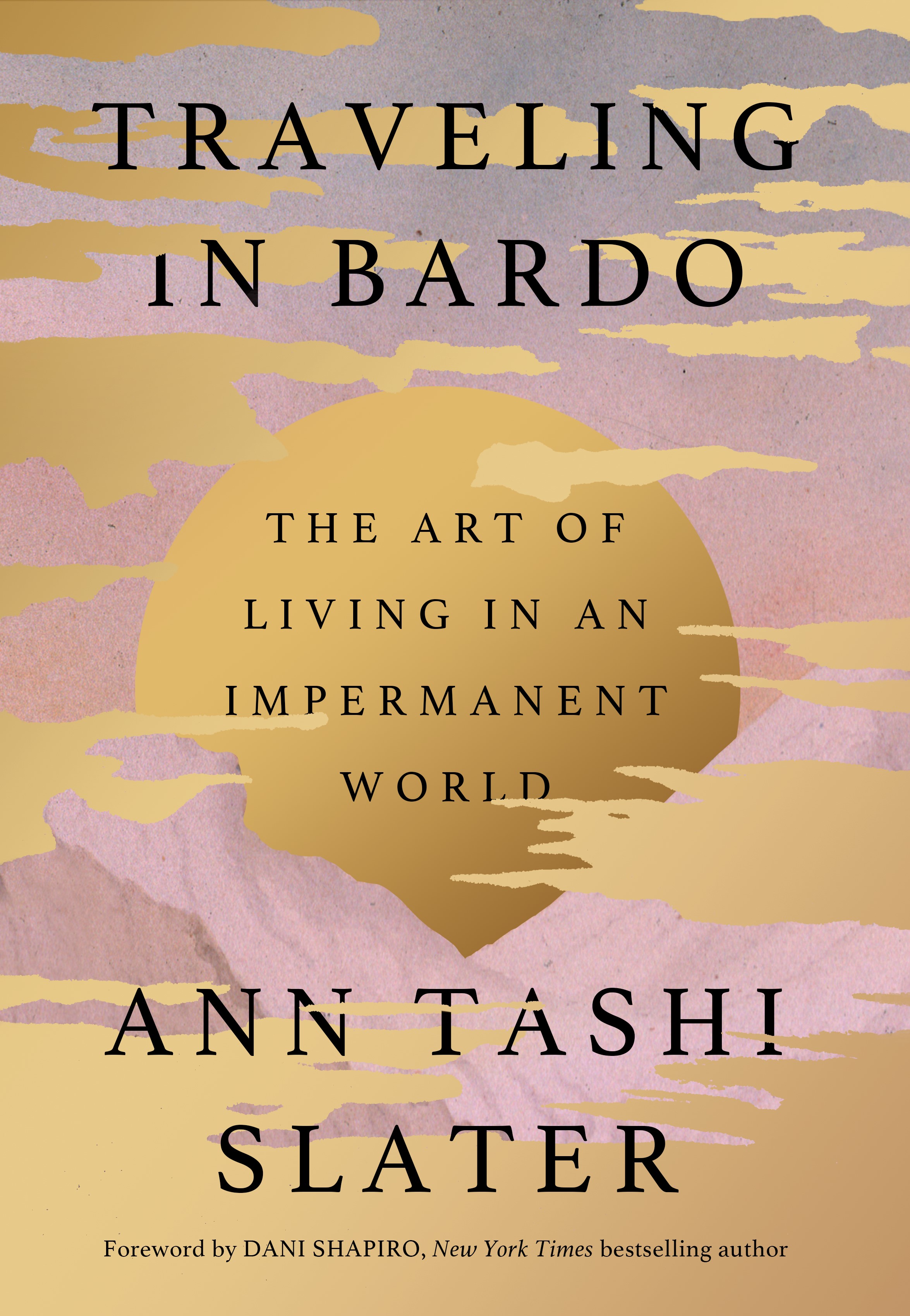
What lessons hang between beginnings and endings? What could small, daily thresholds like the one between wakefulness and sleep teach us about larger, life-altering experiences of death, change, and loss? In Traveling in Bardo: The Art of Living in an Impermanent World, (Balance/Hachette, 2025) Ann Tashi Slater writes about metaphorical caves and liminal states as sources of insight.
Slater’s fiction, essays, and interviews have appeared in The New Yorker, The Paris Review, The New York Times, The Washington Post, and more. She is a contributing editor at Tricycle magazine. We spoke about rebirth, online liminality, turning toward death, and noticing doorways.
***
Olivia Q. Pintair: In Tibetan Buddhism, bardo refers to a between-state, or period of transition, between death and rebirth or between birth and death. While reading about these liminal states in your book, I was thinking of microcosmic examples of bardo: the space between sleeping and being awake, for example, or the strangeness of scrolling on a phone.
Do you feel like there are teachings from The Tibetan Book of the Dead that offer wisdom for navigating the smaller-scale, liminal moments in our daily lives?
Ann Tashi Slater: Bardo is interesting, because within birth-to-death are all these other bardo between-states. It could be the bardo of a relationship that’s ending, or one of the bardos that’s identified in the Tibetan teachings, like when you’re asleep, when you're dreaming.
The space between when you lie down to sleep and fall asleep——I find that a really interesting state. From a Buddhist point of view, it can be looked at as a cave. When I was in Darjeeling doing research, I planned to interview these monks for my book. But then the guy who was going to introduce me was like, Oh, they've gone to the cave. I'm like, What? I need this for my book. I said, Well, that's okay, I'll wait. And he was like, No, they'll be there till spring. “Going to the cave” is a practice where you enter a cave for retreat and reflection and hopefully see something new.
We can understand a liminal space like the one between wakefulness and sleep as a kind of cave. You lie there and think about what you did today or what you have to do tomorrow, or you worry you're not going to fall asleep. Or you can dwell [there] in the same way that you might dwell in a cave, and discover new insight. Often I'll just close my eyes and, for probably the first time all day, think nothing. Different things will come up for me. Sometimes, it'll be a line of dialogue——not for something I'm writing, but as if somebody has just said something to me.
The other example you gave is scrolling on a phone, which we often think of as a distraction, right? The Tibetan Book of the Dead says we can guide our minds in the same way that you guide a horse with a bridle——we can scroll in a very conscious way, an open, attentive way, where we're not mindless but are paying attention to what we're seeing and we’re noticing what our mind or imagination catches on. This is a fertile way of engaging with smaller-scale, liminal moments like scrolling.
OQP: I love the cave metaphor. It makes me think of this image of a womb, and the womb of the earth——apt for rebirth.
ATS: You can go sit in a cave and see nothing. You can be like, I'm cold, I'm hungry. When am I going to get out of here? Or, if we’re open to it, we have a chance for fresh insight. Maybe you'll see something that makes you think about our interconnectedness or that makes you realize something new about someone you love.
Caves are a huge deal in Buddhism and all over the Himalayas. The Himalayan countries and regions have caves where different Tibetan saints are said to have meditated, and people go there on pilgrimage.
Maia Sauer: Do you make choices or set boundaries around your internet time? How do you find those experiences that feel more present and alive?
ATS: The liminality of the internet is a fantastic example of the in-between. For instance, there's a gap online between our private self and our curated self, which we can get lost in. I see it, again, as a question of attention, of what we pay attention to. If we’re engaging consciously with the internet, it's a very different experience from mindlessly looking at things.
How can we live well in the between-space of the internet?I think of it in terms of ritual. Every morning, my Tibetan grandmother went to her altar room in Darjeeling, lit the butter lamps, lit the incense, and prayed to the Buddha and Guru Rinpoche. She ended her day that way, too. She crossed a threshold in the morning and in the evenings——into the day and into the night. It was very intentional. We can think of the internet that way. You can be like, Okay, I'm logging on now. O: Now, I'm logging off.
MS: The ritual perspective is so different from a passive, endless scroll.
ATS: Ritual helps us pay attention. Sometimes, I'll have to go back home if I've just left the house, because I'm not sure if I turned something off. What I try to do when I'm leaving is say to myself, Okay, I'm turning off this light. I’m marking those moments, those thresholds, in the same inner, ritualistic way.
OQP: Considering Tibetan sky burials and the experience of watching your grandmother’s cremation, you write that “consciousness of death allows us to live a more meaningful life.” Engaging with post-mortem practices of bodily transformation, you argue, can remind the living that there is “no time to waste.” What would you say to someone who feels like it’s simply too overwhelming to engage with death on an intimate or visceral level? What do you feel like is lost if we don’t?
ATS: We don't have to engage with death on a visceral level to have a meaningful relationship to impermanence. I mean, most of us are not going to watch the body of someone we love burn, and I probably never will again. I think it's more a question of engaging with impermanence, which all of us experience whether we want to or not. Somebody dies, our job ends, we move.
The Dalai Lama says that he meditates on death every day. If you hear that, you might be like, Why? But he looks at it as a practice for what inevitably is going to come, whether it's his own death or others’. It helps us realize we're experiencing beginnings and endings all the time. We can mark them or notice them, and it doesn't have to be a sad thing. It just is, like the sun setting. We're taught to feel that endings are sad, and a lot of times they are, but often it's just the cycle of night and day. It gets dark and then it gets light again.
If we don't reflect regularly on impermanence, it's much harder for us to navigate endings when they come. In an all-too-human way, we avert our gaze from death and live as if we're going to live forever, even though our last day isn’t a matter of if but when. By reminding us that our time is limited, awareness of impermanence encourages us to live life as fully as possible now.
The apparently paradoxical thing is that we can be happier by engaging with impermanence. So to your question of What is lost if we don't: I think we lose that full engagement with the life we could have.
MS: I'm curious to hear you speak on karma and how you write about our popularized Western notion of it as a kind of hands-off dynamic in our lives. How does a more nuanced understanding of karma actually offer us more agency?
ATS: In the popular understanding in the West, karma means there's nothing we can do. It was my karma to buy this house. It was my karma to lose that money. But karma actually means action, which surprised me when I first heard it, because we think it means fate, as in preordained or predestined.
What I’ve come to understand is that all our actions have an effect. I thought action meant things like taking out the dog or writing a book, but it includes all activities of body, mind, and speech. So it's physically what you do, yes, but also what you think and say. All of our activities have results. There's a balance, a kind of dance, between this agency and, of course, things that we can't control.
So karma is action, and what we do determines our path forward to a great extent. That’s a little overwhelming. You feel like, I should be taking sweeping actions. But what I've come to understand is that changing small things——what in Buddhism are called unskillful behaviors——makes a big difference. For example, when I was young, I was taught, like a lot of girls, that it was important for people to like me. I should please them, their desires should come before mine, and so on. Needless to say, it made me really unhappy, because I pushed aside my own self in favor of what other people wanted. I would say yes when I wanted to say no, and judge myself, criticize myself, for doing that. When I realized that I can, for example, say no when I want to say no, I was able to take a new path forward.
We often think of karma as coming down from our family line, through our ancestors. If your grandfather was an alcoholic and your father was, then it's coming for you——there's nothing you can do to stop the freight train. If I have a fraught relationship with my mother, I’m doomed to have the same kind of relationship with my daughter. We are carrying the past with us in certain ways, but we can also make the choice to do something different in the present moment. And we can expand the idea of karma as action, as repair, from the individual to the family to society. On the societal level, it can be about recognizing past injustices–such as racial or economic–and working to make different choices in the present moment.
OQP: You wrote this book at a time of global mass extinction, in which forces of capitalist extraction and genocidal violence are inflicting mass death upon human and non-human beings at a rapidly intensifying pace. Of course, there has always been violence and there's always been impermanence. At this particular moment in history, though, what do you feel are the political stakes of turning toward death and grief rather than away?
ATS: As you say, there has always been impermanence and there always will be. But turning toward death is not our tendency in America, or in the West. We turn away from it and sanitize it. I remember when my American grandfather died, he had an open casket. They had put on makeup. I was pretty young, but I remember thinking, Gosh, that's weird. He's dead but looks like he’s just sleeping in this beautiful box, with flowers and satin.
We beautify death and we also medicalize it. When my uncle was dying of pancreatic cancer, we should have moved him from the hospital to hospice, but we didn't because we wanted the doctors to keep trying to fix what was wrong with him. There was no chance for him to recover, but we pushed for more tests, more interventions, instead of honoring the passage that was taking place.
On the other hand, with my grandmother’s death in Darjeeling, she sat on the veranda for a few weeks knowing that her body was winding down and she was dying. She was very accepting——everyone was We all felt sad, but there was also a visceral acceptance of death.
Turning toward death and grief gives us a greater awareness that we aren’t immortal, as well as that we can't control all the forces around us. It makes us less inclined towards a zero-sum mentality——every person for themselves——reminding us that we’re human beings living together on this planet, interconnected and interdependent, all subject to impermanence. It encourages us to recognize that since our time is limited, we should do now what matters most, both in our personal lives and in relation to issues like cultural genocide and environmental destruction.
MS: In what ways have you made small choices to pay attention lately?
ATS: I sometimes go from point A to point B with no idea what I’ve passed on the way, but I was walking down the street in Manhattan yesterday, and I looked at each doorway. They're all a little different. Different flowers, different stoops. I love that kind of ordinary beauty.
There's a story in my book, a well-known parable about a monk in a very precarious situation: a tiger is trying to devour him and he's about to fall off a cliff. He sees this ripe strawberry, and he eats it, and he's like, Wow, this is really delicious. The idea is that awareness of death allows us to be more alive to the present moment. We can always notice the strawberry.
I look out at the trees from my study window, at all the shades of green. We think, Green is green, but every tree is a different shade. And every day, the trees look a little different. All things are growing and changing, whether we notice them or not. But we can notice them.