
Black Speck Logic
“Talking about dreams is like talking about movies, since the cinema uses the language of dreams; years can pass in a second and you can hop from one place to another. It’s a language made of image.” —Federico Fellini
1.
I became haunted by an image the way people used to be haunted by images, when images were singular and not immediately overwritten by other images. I’m no philosopher of images, but I’ve experienced the way they can haunt, and the way their plentitude can become the inner membrane of our living consciousness. An image haunts when it is sole and grows in the living consciousness——the easy metaphor for this is a seed growing into a grotesquely overgrown bramble.
Ingmar Bergman’s Persona was conceived based on an image the filmmaker couldn’t stop ruminating over. Bedbound in recovery from pneumonia——and later poisoned by the countless doses of penicillin used to treat it——Bergman found himself in a visual vacuum. He couldn’t read, or watch television, he couldn’t even turn his head to look at the door without losing his balance. Only concentrating on a black speck on the wall was ameliorative; everything else: aggravating.
During the time of Bergman’s incapacitated wall-staring, a friend showed him a photograph of the enthrallingly similar blonde actresses Liv Ullmann and Bibi Andersson sitting together against a wall during a film shoot. They’re devilishly alike, Bergman thought. The resemblance continued “going round and round” in his head until it transformed into another image entirely: the two women seated side by side, comparing their hands beneath oversized hats. This was, he later said, the first image of Persona. The image contained what Bergman called “fertile material,” from which the rest of his psychological film grew. [1]
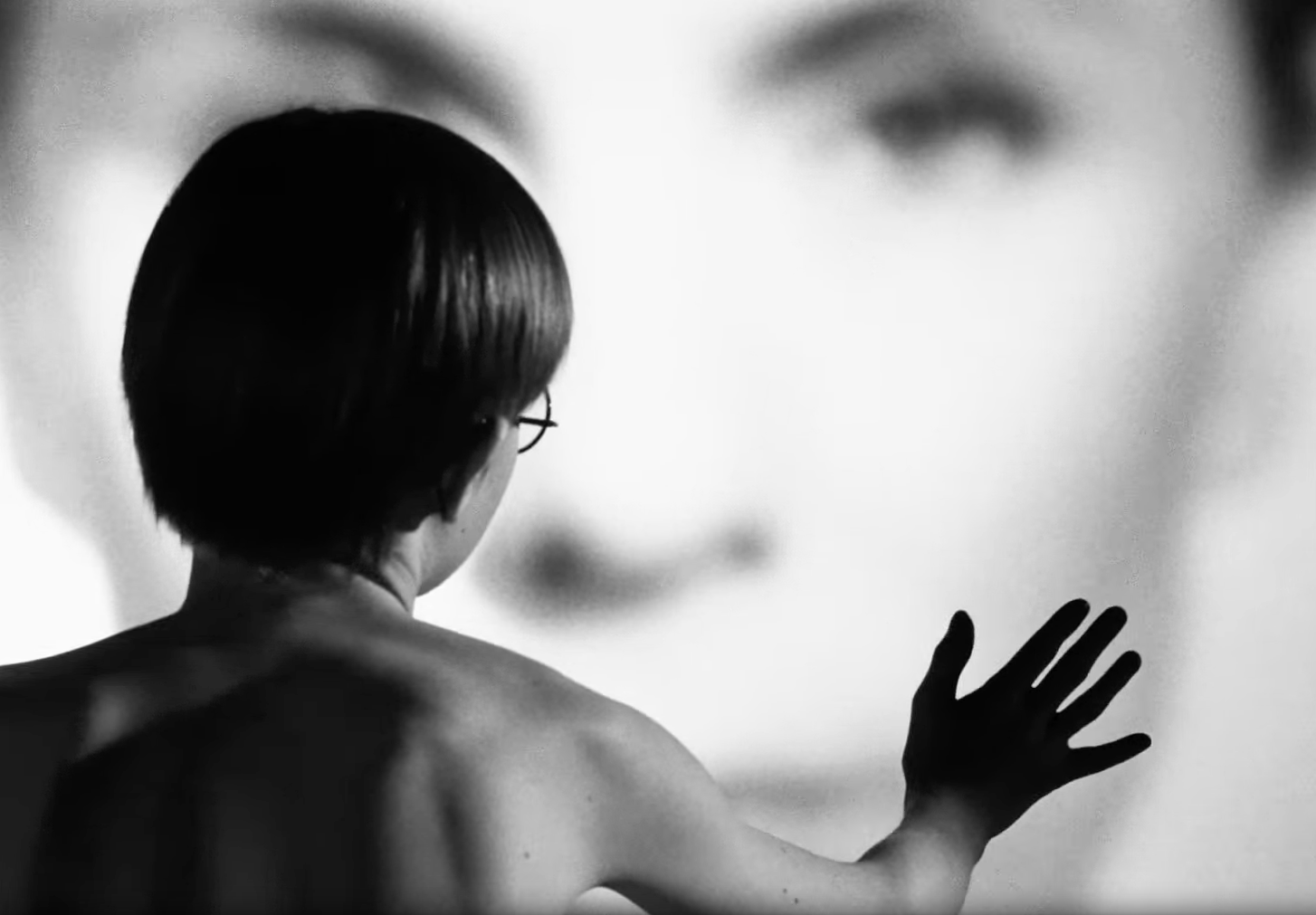
The beginning of Persona illustrates a young boy——at first thought dead, then merely sleeping——who awakens, puts his glasses on, and reaches toward a projected image on a screen next to his autopsy table-turned-bed. He doesn’t touch it so much as grope around its edges as though searching for a way inside. It has always seemed to me that this is Bergman himself. Not the director, exactly, but the consciousness that keeps returning to the same image, trying to understand why it refuses to leave him, trying to understand the secrets to what it contains.
(But we also know that Bergman couldn’t stop groping around in general, so maybe this is a misled thought.)
 Images that         Mutilated           The Falling
 have haunted        children and        Man of 9/11
 civilization        adults from
 since the           Congo
 innovation of       (c.1900-1905)
 photography:


 Alan Kurdi on       The Self-           The Warsaw
 the Beach           Immolation of       Ghetto Boy,
                     Thích Quảng         1943
                     Đức
If you look up any of these images, you will find documentation of world historical events that have shaped our present day. These are images of people dead, dying, in a frightened stupor——horrible, indeed, but embodying specific information about subjects in an historical context. I think the widely shared response of terror and grief to these images makes them impersonal, in a way. The weight——the narrative behind the image——is heavy, but one for all of us to bear.
Every image has a narrative, not only the historical images that haunt civilization. Sometimes the narrative is public, carried by history. Other times it is private. An image’s narrative could be illegible to the person carrying it, and have a sudden effect on someone else. This sudden, hyper-personal effect is what Barthes called the punctum: that element of the photograph that wounds one viewer and leaves others untouched. We become haunted for reasons we cannot entirely account for. Something has grown in that “fertile material” and snags our linens.
The last two images in the list above appear in Persona as stage pieces for the silent actress Elisabet Vogler’s inner life. They appear without explanation——in the interstices of scenes, almost like secrets or asides, interrupting the narrative as though history has breached the membrane of the film.
Bergman understood that certain images, regardless of their historical significance, no longer function as documents once they have been absorbed by the imagination. They become psychic objects, furnishing dreams, obsessions, and behaviors. Elisabet is disturbed and so her personal life is consumed by these specters; or, Elisabet’s life is consumed by these specters, and so she is disturbed. This is the black speck logic: consciousness fastening onto one perturbing image until new life, rife with behaviors and consequences, begins to grow around it.
There is something to say about Elisabet’s role as an actress, as one who absorbs passions and sorrows to perform them back to us. She herself is a living image personified, and Persona is a film about——among many things——the horror of this responsibility.
2.
I met M. in Berlin, where we were on the same fellowship. We became close very quickly, recognizing in each other a similar confusion about our place in the world, in institutions: we were both precocious and strangely laissez-faire, ambitious in a way that made us coil deeper into ourselves instead of finding external validation. Several years after we’d left the wet, cold concrete of Neukölln, M. died.
After his death, I became haunted by an image: a boy in ripped jeans, wearing Timberlands, sitting alone on a raggedy couch with small holes in it where cigarette ash had burnt and calcified polyester into a hard substance. The boy is alone, his head is back, exposing his throat the way Caravaggio’s models come alive in the activity between their neck, chin, and shoulders.
Where did this image come from? I didn’t have it on my phone. Strangely enough, my partner at the time, A., knew it too, despite never having known M. except through story. There were things about A. that had always reminded me of M.——his vulnerability and tattoos, how it felt he’d let life take him anywhere, life was one big tidal wave, a natural disaster we couldn’t control. A. had become haunted by the image as well. Or, in fact, it seemed that A. had been haunted by it long before M. died. Dead, or asleep, groping at the screen.
That summer, the clock was ticking. The invisible hand of time felt like it was speeding up. I had spent the spring in an online screenwriting course; no one was particularly impressed with what I was writing. At the time I was still reeling over the death of M., obsessed with him in the way grief makes you pore over the significance of every action, conversation, and gesture in memory. I would think about us at the park, sitting on his couch, the time he told me he saw me dancing on the subway steps in bliss——I didn’t have the heart to tell him it wasn’t me. Or maybe it was me, and he saw this version that I myself didn’t have access to. All these memories of M.——I had to make a movie.
In many ways, my relationship with A. felt serendipitous. He was like a dream of a memory, or a memory of a dream. A. also wanted to make movies. He wanted to work with non-actors the way Pasolini did, if we could claim to be working anywhere near the lineage of neorealism. The story we had to tell could only be told in a way that was uncomfortable for everyone involved. We aspired to films like Accattone, which is, at moments, unbearable to watch because the tension between the screen and Franco Citti’s uncoordinated body and sun-struck face encapsulates something we ourselves don’t want to face in life. Something a refined, practiced actor’s naturalism could never expose.
Pasolini remarks on the way professional actors “get a bit traumatized because they are used to having to act… real life is full of nuances and actors like to be able to reproduce them… But I hate nuances and I hate naturalism.” His hatred for nuance and naturalism fascinates me——aren’t these the qualities that make good art good?
A. and I put out a casting call and received videos from strangers on my laptop. We watched as these strangers forced their faces into relaxed postures, became aware of their hands moving in space, trying to become people they had never met, who didn’t really exist. Watching the rehearsals reminded me very simply of a drunken holiday game of charades. Someone is given an invisible thing and asked to make it visible enough that everyone else recognizes it, so they will shout and identify it for everyone to see. In charades, the performance is always drunken, slipshod, everyone knows it’s a game. According to Pasolini, this is the core of good cinema.
Pasolini sought to recreate a metaphysics of humanity’s “floored nature”——a term Josh O’Connor, when introducing Accattone for Il Cinema in Piazza in a dreamy, mosquito-ridden castle estate this June, used to describe Pasolini’s films. Floored: stunned, shocked, dumbfounded to be alive in the conditions one finds themselves in. This is the leading affect in films about the ineluctable social realities of midcentury Roman suburbs.
We wanted to represent the floored nature of our world, the desperation of teenagers in an Oregon suburb. The desperation of Berlin, and New York City, and Portland, of our childhoods and the people we knew who had died by the time we decided to make our movie.
The year before, quarantined in Berlin, I had followed the manual, The 90-Day Novel. I finished the novel after homesick A. left me behind, and I absconded to Turin to spend the remainder of my European era languidly in the shadows of my beloved Nietzsche. The novel was supposed to be about an awful roommate. Instead, it became almost entirely about M. This was before he died.
Which is to say, there is proof that I was haunted by him before I had a reason to be. I was trying to account for the impression he left on me. Knowing other people who knew M., I suspected he left a similar imprint on them. Even while swallowed by addiction, he had a supernatural tendency to bring people together. It felt like one of those contradictions Simone Weil would have recognized as truth.
I learned of his death through Instagram stories; mutual friends posted “RIP” and it was hard for me to tell if he was really resting in peace or just “RIP”-ing. The community held a candlelight vigil on a rooftop in Chinatown. I regret not ever having lived in New York with M. Sometimes I’ll be walking in the East Village and have a false memory, longing for him in a daydream of him showing me some dusty bookstore. Soon after the IG stories, someone in our friend group reached out to tell me M. had overdosed after a concert, alone in his apartment. It was the era of fentanyl. I hadn’t known he was buying heroin.
Looking back, making the movie feels like an attempt to move the haunting image outside myself. Perhaps the only way to exorcise an image from consciousness is to create a living version of that image outside of consciousness. Maybe this is the process we call “making a movie.”
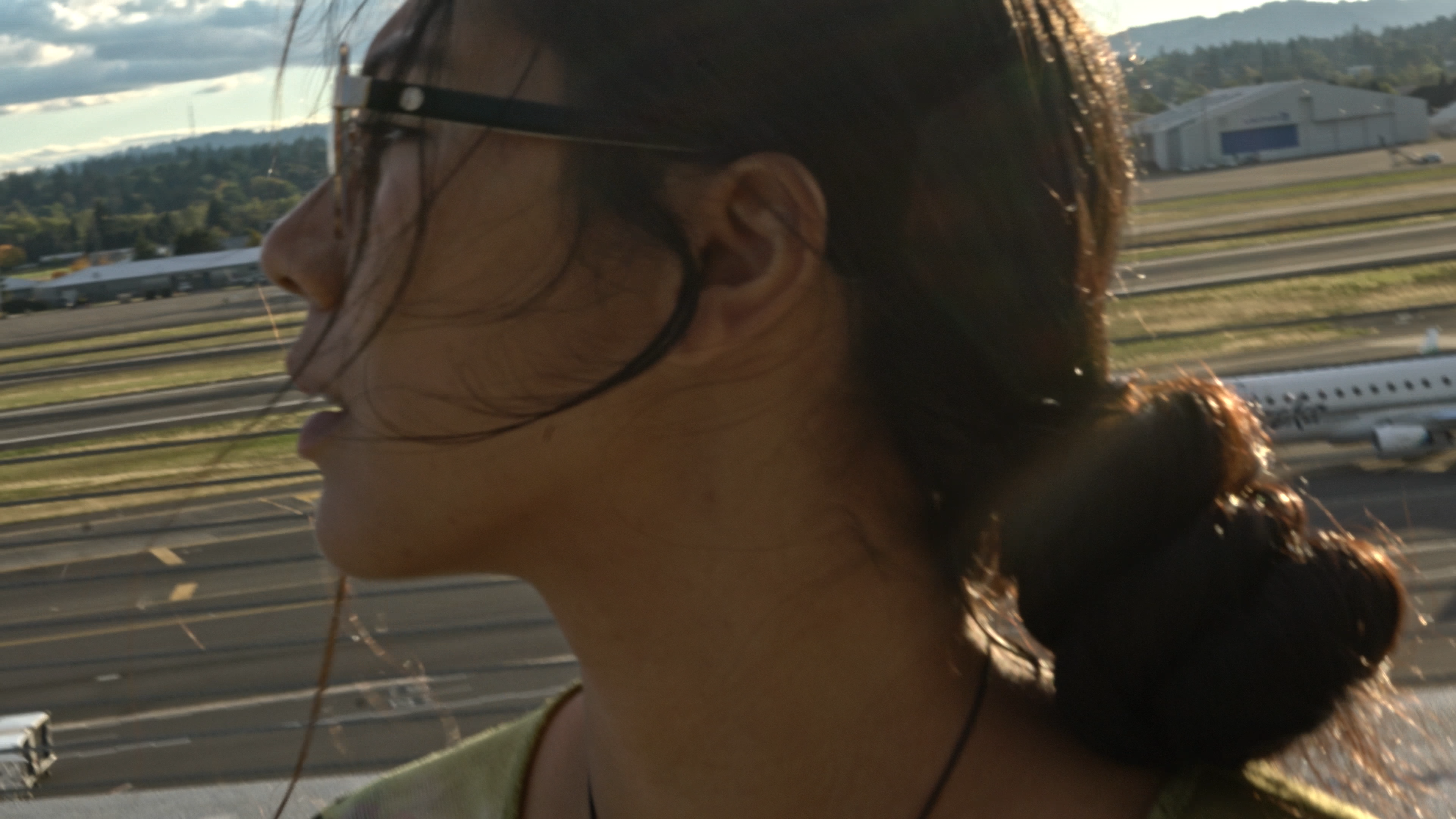
Eventually, A. and I flew an eighteen-year-old SoundCloud rapper from Iowa City to Oregon. We found a Filipina commercial actress to play me, and a lifelong addict to play the character based on M.
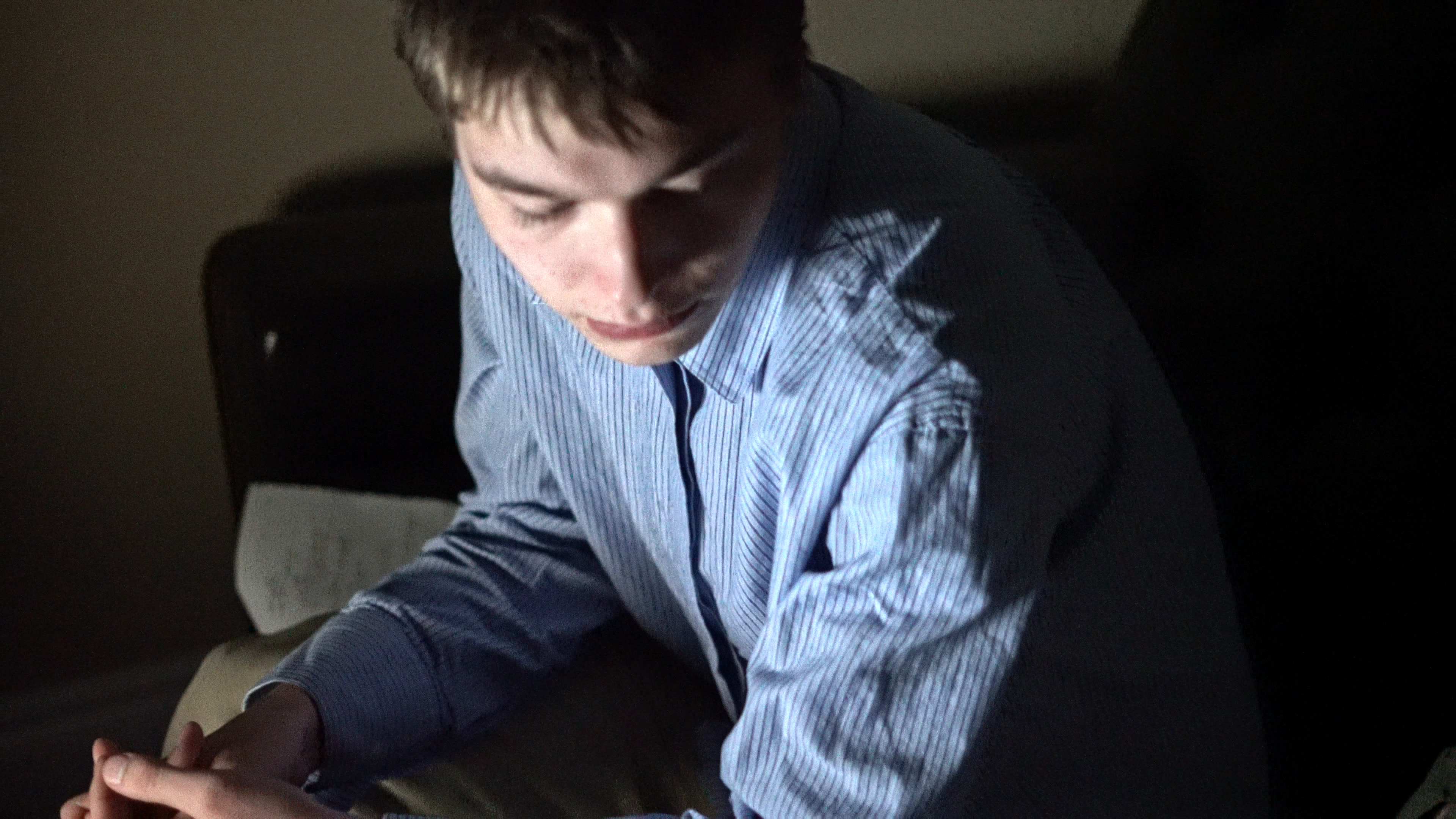
We rented cameras, a boom, a mixer. Our boom op––my best friend’s ex, a DJ who was perpetually stoned——lost half the microphones and cost us an extra $400 on a non-existent budget. A. and I spent months scouting locations that were significant to our relationship because the film was——after all——also about us. We designed sets inside our childhood homes. Costumes came from our closets. We crushed vitamins from Walgreens into very convincing lines of cocaine.
Making the movie felt like stepping outside the flow of life and into a world hovering just beyond our sense of time——somewhere both past and future. Looking back, I remember very little of production; what lasts is the feeling of entering another temporality, or exiting temporality altogether. The days no longer accumulated toward a future. They accumulated toward an image. There was something enchanting about this——and maybe this is what is meant when they say movie magic——to exist in the strange faith that an image could exit one mind and begin living inside many others. To have all our efforts working toward one shared and perfect picture.
3.
When I was a child, my dad used to bring my brother and me to watch airplanes land at Portland International Airport. We would stop after one of my brother’s therapy appointments and park beside the runway to eat McDonald’s while jets roared overhead. I remember the diced pickles more vividly than the airplanes themselves. The raw onion and the smell of gasoline. Young couples leaned against their cars watching departures with an intensity I couldn’t understand. Heat emanated from their idling car hoods. What was the romance in watching planes? I always thought the activity was unbearably dull.
Years later, I found the same airport in Chris Marker’s La Jetée. Marker’s protagonist remembers almost nothing from childhood except standing on a flight observation platform at Orly. Here, he remembers a woman’s face, the camera captures her static profile in close-up: the graceful contours of her cheeks and nose, her hand held sensuously to her mouth. “Nothing sorts out memories from ordinary moments,” claims the narration while the camera hovers on her iconic portrait. “Later on they do claim remembrance when they show their scars.”
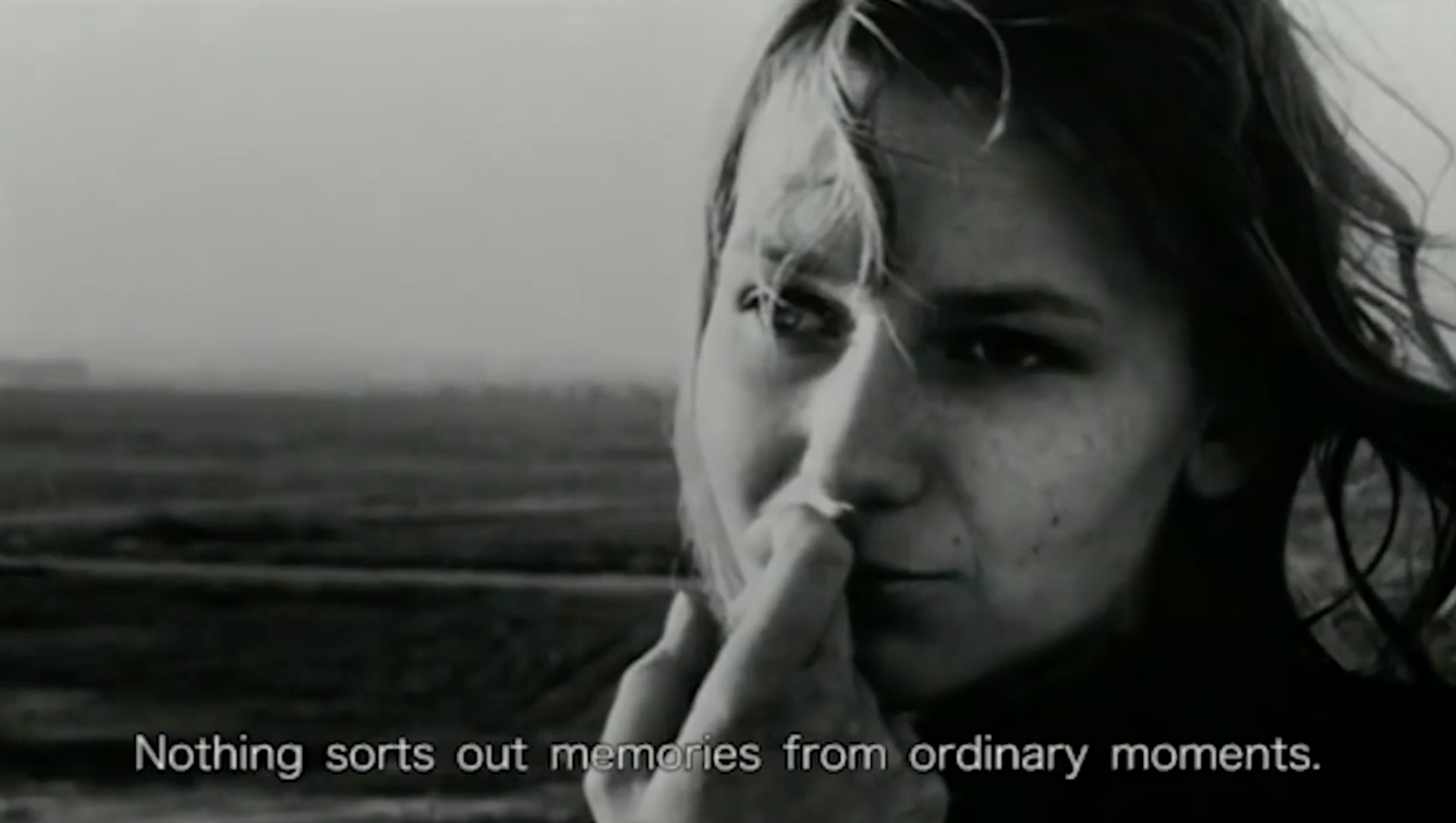
Action seizes the scene, a man seizes and falls, fear coruscates across the crowd. Only later does the boy––now a man––understand that this innocuous memory of the woman’s face was one of tragedy: the collapsed man had fallen to his death. A single shot captures the incomplete “crumpling” body of a man in the blurry foreground, and the woman with both hands brought up to her face in a gesture of Munch’s The Scream. These images follow the former serene portrait, behaving almost as corrections to the boy’s pleasant memory. “Later, he knew he had seen a man die.” When did this “later” happen? Did it happen when he knew that he would not understand something so lovely, unless something terrible existed in its shadow? The memory of the woman’s face is both a key and screen to the violent incident.
Later still, in a post-WWIII subterranean bunker——under the pressure of an experiment to recreate the flow of time——does the man discover that this memory is not only a key, and screen, but the architecture of the entire future of humanity. During experiments as a prisoner, he time travels to that memory. These memories warp around each other, mind-images turning something like cinema. The woman becomes the protagonist, and eventually his lover. A memory-cinema unfolds.
Memory-experiments are performed on the man so he can generate the future out of his of image-repertoire. What is revealed is drab and hostile. Despite being the shackled subject of an experiment, the man has agency in his memory. Instead of pursuing the future––as the whispering German lab technicians hope for––the man wants to remain in the past, with the woman, with the time that this single image has produced. His return to the image of memory ends up fatal; he crumples; the future remains lost.
“Where did the future go?” a new email in my inbox asks me. A profound question, I think, to be composed of white, black, and blue pixels on my screen.
Where did it go, this future?
In the era of H. G. Wells, the future was populated by flying machines and impossible technologies that promised to collapse space and time. By the 1990s it had become a techno-dystopia of cyborgs, corporate megacities, and bloodthirsty artificial intelligence. This was all before I was able to conceive of a future, and none of them arrived as imagined anyway. Imagining them, in fact, was a bit of a fool’s errand: perhaps we have learned that images of the future cannot be predictive, merely decorative. But some images were powerful enough that humanity could collectively inhabit them. Before there were moon landings, there were illustrations. Before artificial intelligence, there were stories.
Is the past the keyhole to the future? Are dreams the carrying out of past images? Much like our dreams, the future is a rapprochement of pre-existing images. Much like dreams, cinema occurs as a stream of images taking place while we sit still inside of a black box.
Do you dream in actions or in images?
La Jetée is a film composed of still images. Plane trees in Paris; a taxidermied animal zoo; a hand reaching for a doorknob. They remain perfectly static until some tiny movement——a head turning while in bed––suddenly wounds the sequence. In La Jetée, memory’s subject moves her face in bed and it shocks you––the viewer––alive, brings tears to your eyes. The sudden movement in the stillness of 260 images, 28 minutes of time, sends frisson down your spine. Time has suddenly begun; how uncanny it is to realize it had not yet started.
Simone Weil believed that time is an image of eternity, and that we are eternally lacerated in our sense of time. I have begun to wonder whether images are themselves small eternities. They wait patiently inside us until time catches up with them, or is produced from them.
Looking back, I no longer think the movie we made was an attempt to remember M. Nor do I think Bergman made Persona to understand the photograph of two women comparing hands. I do, however, think that the protagonist of La Jetée created a new flow of time in order to be with his memory-image. To understand vs. to be with. This protagonist isn’t allowed to live in this new time, however; he returns to the airport——the beginning——and it ends.
In our movie, the airport is the location of the beginning of the end. It is where the future collapses, or where the present extends itself in a grotesque and lethal gesture towards the future. A girl leaves a boy for an indeterminate amount of time. In his grief, the boy makes an irrevocable decision.
The airport in the movie is the same one where my dad took me and my brother when we were kids. Then, I could only ascertain the boredom of the experience and the muck of McDonald’s, but now I am curious what my dad experienced while watching the planes. In 1989, my dad flew from Manila into Portland and never returned. As a child, I thought airports were places where people waited with junk food in a romantic stupor; cinema understands them as places where time folds, places where lives divide into before and after. The runway was my dad’s first image of his American life.
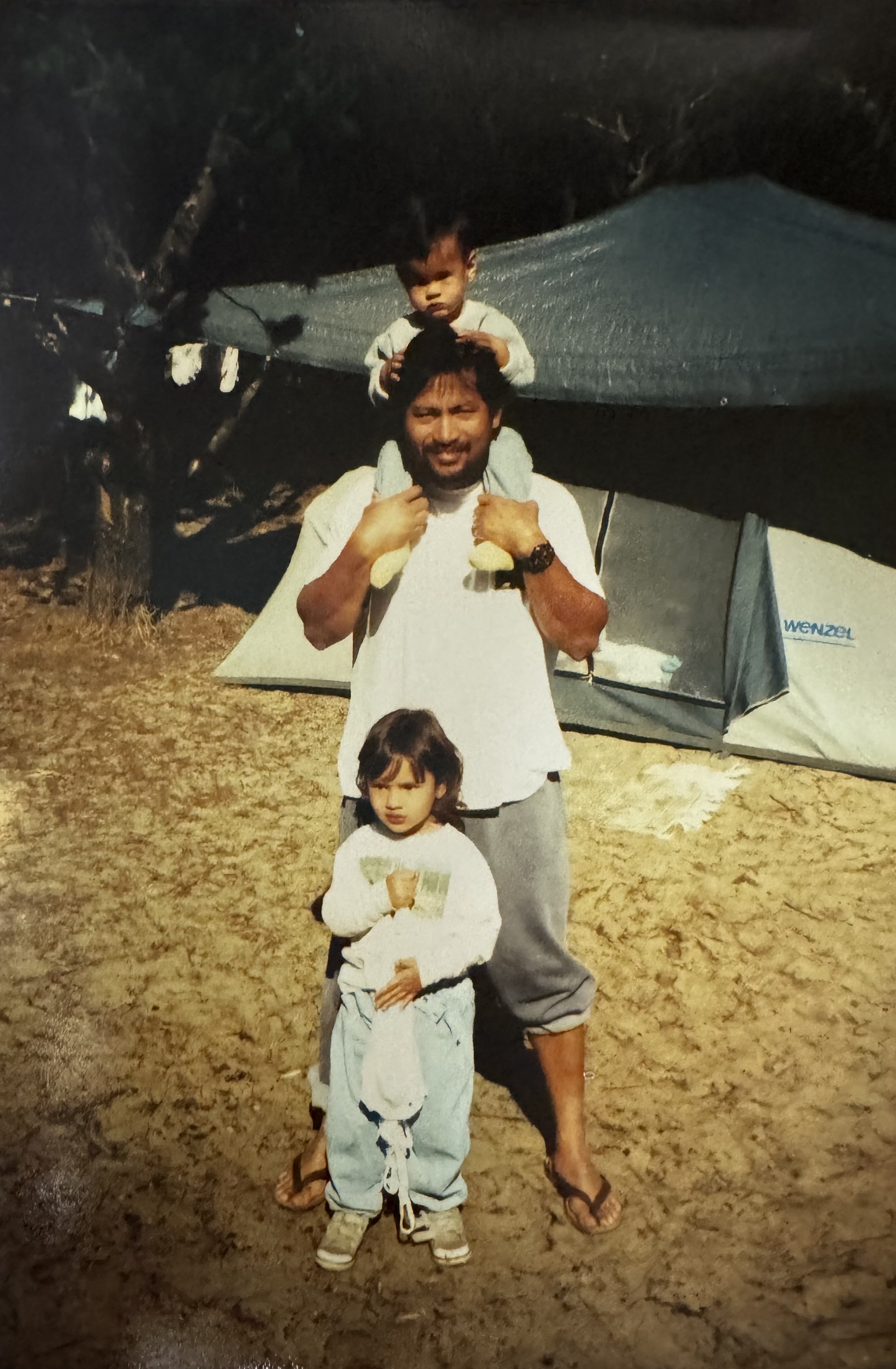
Staring at airplanes like Bergman’s black speck on the wall, life too vertiginous to attend to anything else and with his children in the pickup, my dad watched the planes arrive and depart. Fifteen or so years before, he had flown 24 hours from the dense coconut jungles of Samar into the temperate air of Oregon, where he’d carry out the rest of his life. A recurring nightmare of planes: leaving and arriving, never leaving, never arriving? Or was it a dream of leaving again?
Some images are not documentation. They come to us in the blank space of our consciousness. Maybe our mind’s eye——our third eye——maybe in dreams. Specters begging to become real. Perhaps these images have greater resonance with reality than anything that could have been reproduced from them.
At the end of the summer, we had twenty-seven hours of footage, which became a 90-minute film. This was documentation of the spontaneous and radical intimacy between strangers that occurred over five days of shooting. Yet, the image of the boy on the couch didn’t exist anywhere. We had represented it imperfectly, the truth told slant, the moving-image of it a social creature, not a haunting one.
It wasn’t on my phone, or A.’s. There was no proof we had witnessed the same scene, and yet we remembered it together. Where did it come from?
---
[1] Ingmar Bergman, Bergman on Bergman, 196.
Ellena Basada is a writer and editor living in Brooklyn. She is an Axinn Fellow in Nonfiction at NYU and editor at Fonograf Editions.