
On the first day of a writing class I took with Valeria Luiselli this past spring called Beginnings and Endings, she gave us a Greek translation guide and asked us to decipher the word, ενθουσιασμός. Sitting around a mirrored table, we converted the letters slowly, each arriving at some version of enthusiasmos. This is the etymological root of the English word “enthusiasm,” Luiselli said, which contains the Greek roots for “in” (en) and “god” (theos). “To experience enthusiasm is thus to be inhabited or possessed by a god,” she explained.
“Enthusiasmos sounds similar to the Greek word, siesmos,” Luiselli continued, “which pertains to earthquakes—as in seismic activity. If we put all the bits of it together, the false, but equally wondrous etymological origin of enthusiasmos would then be something like: ‘to be possessed by a god and experience an internal tremor.’” What would it mean to think of an earthquake, for example, not only as a catastrophic backdrop to human life, but also as an expression of gods who inhabit the earth?
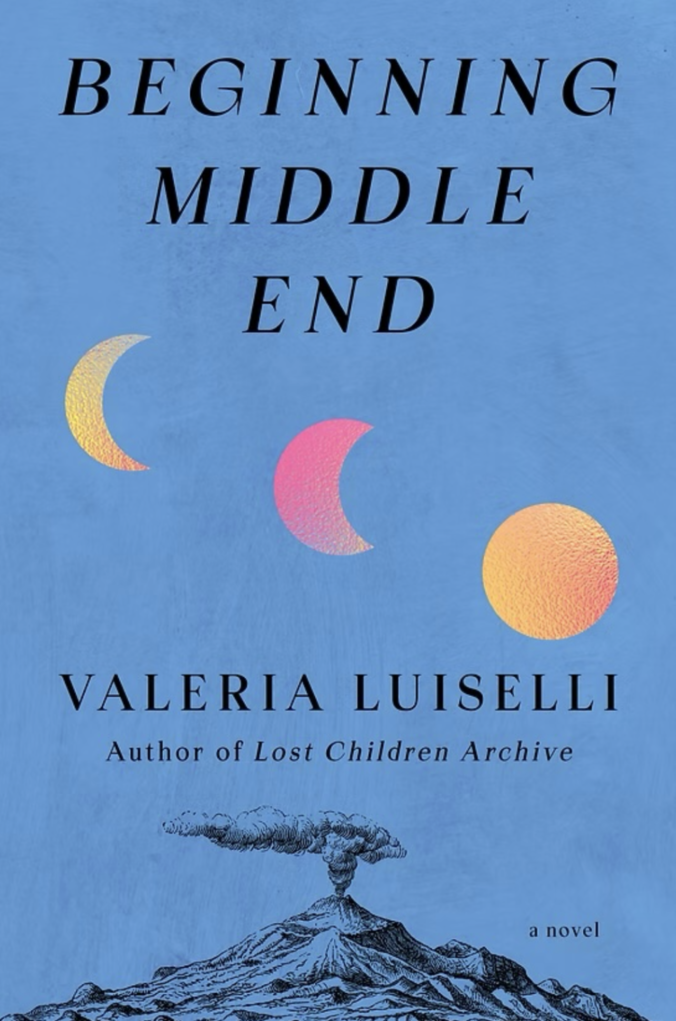
In her new novel, Beginning Middle End (Knopf, July 2026), Luiselli continues to ask questions like this. The story follows a mother and daughter through a Sicilian summer full of shifting winds, volcanic fires, and oceanic change——both personal and ecological. How does one reimagine beginnings in a moment when end-of-world narratives are everywhere? the narrator wonders amid her own collapsed marriage, her daughter’s emergence into adolescence, and her mother’s fading memory. What is it to begin again, after the end?
Valeria Luiselli was born in Mexico City and grew up in South Korea, South Africa, and India. She is the author of Sidewalks (2013), Faces in the Crowd (2014), The Story of My Teeth (2015), Tell Me How It Ends (2017), and Lost Children Archive (2019). She is the recipient of a 2019 MacArthur Fellowship and the winner of a Dublin Literary Award, two Los Angeles Times Book Prizes, the Carnegie Medal, and an American Book Award. She teaches at Bard College, Harvard University, and New York University.
We spoke about metamorphoses, nature writing, soundscapes, lamentation, and stolen artifacts.
***
Olivia Q. Pintair: You write about Proteus, a shapeshifting sea-god who appears in ancient Greek texts like Homer’s Odyssey. Could you talk about how you first encountered Proteus and how his myth is connected, for you, to the process of writing?
Valeria Luiselli: I’ve noticed that when I’m reading, things often start appearing and reappearing until I have to pay attention. The first time I read anything about Proteus was in 2021. I was in Baja California, around La Fortuna, where I was staying alone, trying to get some writing done. It was whale season, so I was swimming every morning, because in the early morning, you could hear whale song underwater with your bare ear. At that time, I was reading Steinbeck’s The Log of the Sea of Cortez, and that is where the myth of Proteus first appeared to me. Then, he reappeared in Alice Oswald’s Dart, at the very end. This started happening over and over. I was reading Pliny’s Natural History, and Proteus reappeared there. And then again in Ovid, very briefly. At some point I was like, fine, okay, you're interesting. I will pay full attention now. I suppose it’s a mytho-magical way to interpret literature, which is maybe not so contemporary. But it was through reading and rereading that this relationship began.
One of the first scenes that I ever wrote of Beginning Middle End was the scene where the mother and daughter go to a fish market and buy the head of a swordfish. I knew that the daughter was somehow going to leave her mother and take the fish head somewhere, but for six years, I didn't know what had happened to that swordfish, or what its meaning was. I intuited that when I figured out what had happened to the fish, I would have finally solved the novel. When Proteus came into the novel, he became a way for things of the story——like this head of a fish——to undergo metamorphosis and reappear in different manifestations. Eventually, Proteus became the possibility of time and change within the novel.
OQP: Beginning Middle End threads multiple voices together——among its speakers are the narrator, her mother, her daughter, and also nonhuman entities like the elements and ancient texts. How did you orient to voice and collaboration while writing?
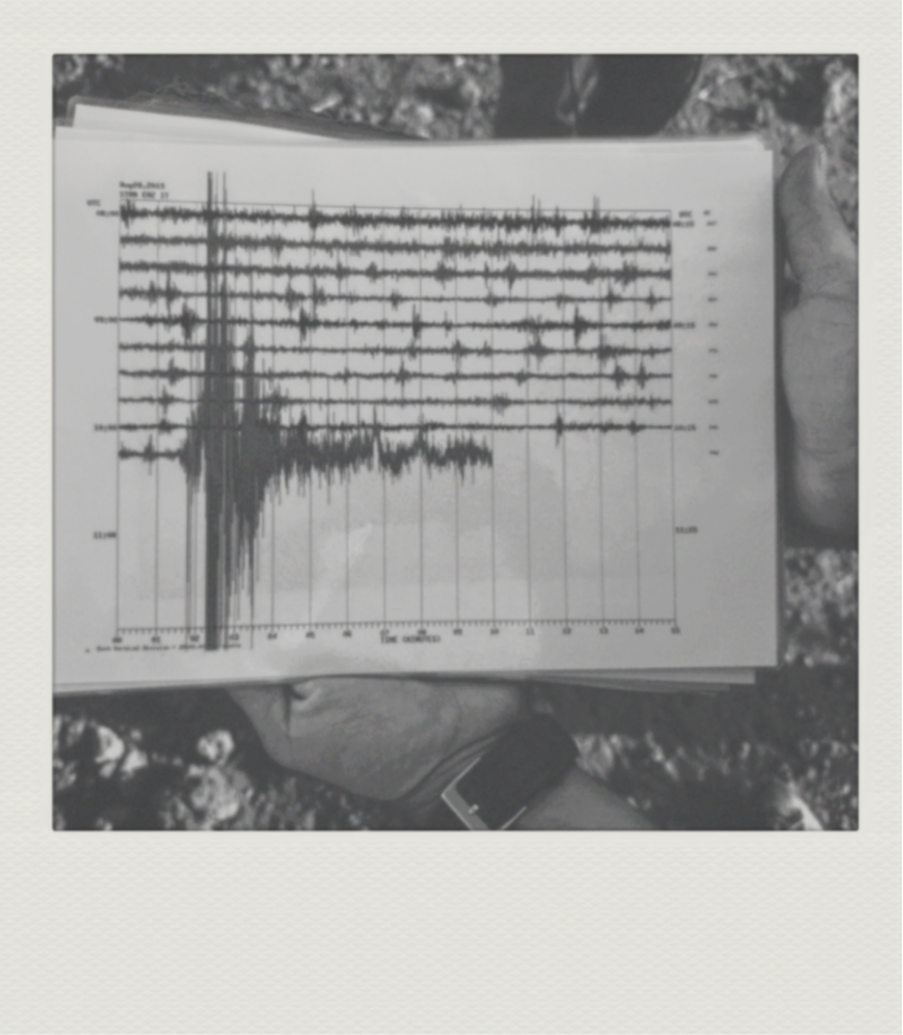
VL: There were two forms of collaboration with respect to voice. One is the sonic book, which includes soundscapes made on site in Sicily and in the Aeolian Islands, composed from underwater recordings, volcanic reverberations, surface volcanic activity, winds, gales, storms and tempests, as well as voices of fishermen and sailors. Everything was recorded manually, using a combination of hydrophones, geophones, binaural mics, and shotgun mics. There’s a QR code in the book that will take you to the link to buy this audio version. We also decided to make a web page in order to give readers a little more. It’s a kind of archive, which includes raw recordings, field recordings, and some visual components.
In terms of the girl and her mother… Maybe in all my novels there are at least two narrators that serve different purposes. I always feel I reach a limit with a narrator, after which it no longer makes sense to leave them the role of storyteller. This novel was all about understanding that one has to hand off the narrative to the next generation. That adults are not the makers of world narratives on their own, but at some point have to truly listen to the questions and rearticulations of narrative that come from younger minds.
I received a lot of very concrete help from the young people around me, but primarily my daughter, who is now 16. Now she’s reading Virgil and The Odyssey, but when I started this novel, she was 10. I feel like I got a chance to observe her transition from childhood to adolescence very actively through writing this novel. She was very invested in me finishing it. She was like, So, okay, so what did you write? Oh no, that doesn't work. We had very good conversations throughout.
I believe profoundly in collaboration, and my daughter has been a collaborator in my work since she was very little. I once wrote a piece called Swings of Harlem, which is a visual map of all the swings in Harlem placed alongside little stories. I didn't have a nanny, I didn't have money, I was 28, and so I spent my afternoons with my daughter on different swings. We'd take a picture, and while she swung, I’d make notes. I was a young mother. There was no way for me to not integrate motherhood into my writing. I wanted to write very deeply from within the messiness of that space.
OQP: Did you ever feel like you and Proteus were collaborating on Beginning Middle End?
VL: I'm a bit of a pagan, as you now know. I think there are a multiplicity of divinities and forces of nature that rule our lives. It's not that I believe in them to the point of subscribing to any one particular religion——if I had to choose, I would be more polytheistic——but yes, I feel that there was a presence, of sorts, guiding me through in understanding change in metamorphosis in the story.
I was recently in Casale, in the Villa Romana, where part of the novel takes place, with my Italian publishers. They wanted to record a little video there while I was on book tour, but had to ask permission to record, since it's a ruin. They sent my novel to the mayor of the little town and the Head of Culture, who read it and then gave us permission to go. When we arrived at the ruins, they were waiting for us in this very formal, Italian, bureaucratic way. The head of culture came up to me and said, Valeria, nice to meet you, Head of Culture, my name is Ettore. I've read your novel, and I just really would like to ask you if you are indeed in possession of a stolen mosaic from my villa, like the narrator in the novel is.
I could have just told him the truth, which is that sadly no, I’m not. This is fiction. But I decided that it was very in-keeping with Proteus to just leave him without knowing. I just kind of smiled and said, unconvincingly, no…
OQP: That’s amazing. What was his reaction?
VL: He got all serious. Now they've been contacting me from Casale through my Italian publicist, knowing that I'm going to be in Sicily in July. They want me to do a book launch at the ruin, so I wonder if they want to press on the issue.
OQP: How do you approach writing about the nonhuman world? Are there particular ethics, ideas, or lineages that shape your approach to so-called “nature writing”?
VL: While making notes for the novel, I started to collect a lot of books about the ocean——histories of the ocean, different takes. A lot of them are deeply disappointing, because many books on “nature” are written from the point of view of the “hero” or “explorer.” It's a point of view that I don't find very attractive or engaging. But then, there are Rachel Carson's descriptions of the ocean, for example, or Alice Oswald's Dart, which are both doing something very different.
Empedocles, the 5th century Greek philosopher who first theorized earth, air, fire, and water as the constituent parts of all matter, was born on the island of Sicily. The more time I spent on the island, writing about the Empedoclean elements, the more I wanted to pay very close attention to them, not as a backdrop against which human action takes place, but as the center of our very lives. I started recording winds here and there, but at first, the recordings weren't very good. During the last two years of writing the novel, I went back for recording trips with two collaborators. We recorded volcanic exhalations, underwater tides, and tempests. We recorded a lot of different winds. The novel was finished in English, and then rewritten in Spanish, and then there was this third translation, which is the sonic translation. I conceptualized it as a kind of Greek chorus. It accompanies the text and acts as an emotional undercurrent and an ethical compass. It is never an illustration of action, just a creator of space.
I feel that I still have a long way to go to do that better. I feel that this novel was a start, which came thanks to the work I've been doing in Echoes From the Borderlands, a recording project that maps the Mexico-U.S border. I thought at first that we were mainly going to record the human world along the border, but then I found myself doing quite the opposite. We would sit for hours recording a dust storm in the Sonoran Desert. Or spend hours listening to whales and their migration patterns, or to the sudden tempest in Texas, or to the Rio Grande.
Sound asks you to sit in time differently. All you can do is sit and listen while recording. Even while editing the material, you have to sit and listen for everything. You can't scroll sound.
All of this allowed me to write this novel with a very different ear toward the presence of the nonhuman, but I still feel that I have a ways to go. One day I would love to write something inspired by Pliny the Elder’s Natural History, trying to observe and listen to the same things he recorded almost 2000 years ago in those volumes. This feels to me like a lifelong project, and I worry that I might be starting too late. Pliny began writing Natural History when he was so much younger, and he read quite literally all day, or had people read to him.
OQP: Right. You said once that he would even read in the bathtub.
VL: Exactly.
OQP: That makes me think about time, and time travel. At one point, the narrator’s daughter says: “It’s not that I believe in time travel, but also I don’t not believe in it….What I do believe is that someone from the past can show up in the future once they are dead, because their soul can travel and become different things.” Here, travel through time is framed as a kind of metamorphosis——a process of things “becoming different things,” in a material sense.
VL: I’ve been thinking about writing as a practice of noticing. When we exercise noticing as something active——not dispassionate, but very in-relation to what we observe——I think we can start to see moments in time as both solid and moving. With a certain kind of attention, we can “freeze” time enough to notice it, but then notice it enough to see it as transient, and to feel it corporeally. Sometimes, for me, this manifests as a kind of nostalgia for the present.
Part of the discussion around time travel in the novel is about the possibility of cultivating a more caring relation to time, and to where we are when we are there. In terms of the belief about “things becoming other things,” I mean, I don't see any other better explanation. This is perhaps outside the realm of literature——or perhaps this is purely the realm of literature——but it seems to me that it would be a great contradiction for nature, which is such an efficient, complex mechanism of interrelated things, to waste so much energy creating consciousness for it to just expire, instead of mutate and metamorphose into something else.
OQP: The novel is also organized into four parts, which are named after four winds that are widely known in Italy——Levante, Ponente, Scirocco, and Mistral. I’m thinking about how names can support a depth of relationship to specific beings and forces in the world, but can also objectify processes or limit our creative perception.
VL: Winds were something that I had not paid attention to in my life, before encountering the lore of the Mediterranean islands. I am now very conscious of the winds——how they start, how they sound, how they make us feel. There is one particular wind in Italy——the Scirocco——that makes people angry or anxious. There’s some, like the Mistral and Tramontana, that make us renewed. I think we really need to come up with names for the winds here in New York.
There is a paradox, though, because naming can also be a way of possessing. There are forms of knowledge and possession that can be extractive, or abusive to what you are trying to know. How does one draw a line between the kinds of knowing or naming that support relationships, versus those that involve violence or consumption?
OQP: Violence is an undercurrent in the novel in a way that reminded me of Ovid’s Metamorphoses. Like Metamorphoses, Beginning Middle End is a story of transformation, which is haunted by stories of sexual violence. There is the thread about femicide in classical texts and in the world. There are references to the Chilean feminist collective, Las Tesis. Much of the novel takes place within earshot of bells ringing from the church of Saint Agatha, who is the patron saint of rape victims. How did you think about the relationship between violence and metamorphosis in the novel? What was it like to work with that layer?
VL: What a great question. I’m thinking of Trojan Woman written by Seneca. In the opening scene, there is this image of a chorus composed of the women from the devastated Troy, who gather around Queen Hecuba to mourn the fall of their city at the hands of the Greeks. They engage in a collective lament for their home and for the further violence that they are about to be subjected to. In the novel, I place this image——of the bare-chested Trojan women covered in ash, full of collective rage, in relation to images of the female choruses that have sprung up in Latin America and around the world. In 2019, LasTesis performed “Un Violador en tu Camino,” a performance piece protesting sexual violence] in Mexico City. It’s incredibly striking. The entire central square of Mexico City is filled with thousands and thousands of women.
I had been trying, for years, to stage a version of these scenes overlapping. A while ago, I started traveling more and more to a little border town in New Mexico called Shakespeare. It was a mining town, and then a ghost town, but the current owners have turned it into a kind of Disneyland-ish representation of itself. People began to use it to hold reenactments of wild west shootings and lynchings. On any given Tuesday, there would be people there practicing lynching reenactments. At one point, I went and interviewed the reenactors. I asked them how they might imagine different reenactments, other than the scenes they tended to repeat, which were very predictable. Doc Holiday-esque. Someone getting shot in the head three times for stealing an egg, or something. They gave me foreseeable answers. They came up with more of the same.
When I left Shakespeare that day, I went to visit a nearby cemetery. There were all these graves, mainly without names. The names that were there mostly belonged to early Mexican inhabitants of that area, many of whom had been killed. I decided then that one day I wanted to stage an alternative reenactment in Shakespeare——some version of Seneca’s Trojan Women, about the women who have lost their lives crossing this desert. Women who have been trafficked across the border. I imagine this as a kind of ongoing sonic play that speaks to different forms of violence, not just from a place of victimhood, but also as a way to transform pain into political energy. For this, I might need to buy Shakespeare back, because now it belongs to this rancher.
Perhaps, some element of this idea found its way into Beginning Middle End. What usually happens during the process of writing a book, for me, is that there are always failed novels or projects nested within the novel. Old seeds that haven’t yet come to fruition.
OQP: You write about water in relation to memory. There are “swelling tides that threaten to erode and eventually flood the mind as it ages.” You also reference a line from John Steinbeck’s The Log from the Sea of Cortez, which calls the human unconscious a “mass of sea-memory, or sea-thought.” Can you say more about this association?
VL: In the book, there is a reference to the short story Shakespeare's Memory by Jorge Luis Borges. In it, a character is offered Shakespeare's memory, and he's like, okay, I'll take it. The next day when he wakes up, he is inhabited by two sets of memories: his own and Shakespeare’s. The writer Ricardo Piglia interprets this story as a kind of allegorical piece about literary memory. We, as readers, are like that character, he says. We have our own memories and we also have borrowed memories from everything we've read.
I would take it one tiny step further, and say that there are not just two distinct streams of memory. Memory is oceanic. It’s very watery. It’s not like you can't tell what you’ve read and what you’ve lived——you can——but the very substance or scaffolding through which you construct your own memory of lived experience comes from who you are as a reader. Memory is shaped by the things you read, the way you piece together a narrative, if you choose to be a victim in the story or or an epic warrior or something, or if you remember events under a certain melancholy light. There is a watery intermingling of reading and living, where, in the end, it makes no sense to distinguish so sharply between the two. What you live and what you read both shape memory’s structure. This places a big responsibility on us as readers.