“I ask now of the book: Where do these poems begin in geologic time?” writes kathy wu in the afterword to her debut collection, She Will Last as Long as Stones (Wendy’s Subway, 2026). She replies, echolocating herself in language: “The poem always comes from the body. / The poem emerges. It comes from a cacophonous space: a billion people talking, all at once——”
Through the immensity of that sound, of working with stones as alphabet and ephemera, of possibilities fashioned through collapse, wu constructs linkages, ruptures, and meaning made anew. Her book also features data from the United States Geological Survey, circuit diagrams, somatic prompts, and (mis)translations of conversations with her mother. “I thought the stones would answer,” wu writes, “as if grief was a question.” The answers here are multitudinous, many-limbed, “made out of mud,” moving and “micaceous.”
wu is an artist, poet, designer, and educator who works across language, computation, fiber, and book arts. They teach graphic design, poetry, and computational arts.
In an interview, we spoke about structuring one’s own poetics, reaching across modalities, glitchiness, syllable-izing grief, and obsolescence as death and beginning.
***
Jenevieve Ting: You open your collection with a quote from Édouard Glissant’s Poetics of Relation, which I found fascinating and resonant with your work. In that book, Glissant writes, “I build my language with rocks” and in your poem “The Desert Says,” you write, “Sand is a million tiny words. Sand promises, The end won’t be all that different from the beginning.”
Could you tell me a little bit about your relationship to geology and language?
kathy wu: As a poet (and non-geologist), my immediate comparison is this: For me, language and geological matter are both portals to the deep past and the deep future. I’m drawing from predecessors in this work; for example, Pauline Oliveros’s Deep Listening scores, which reveal how the body is activated by language and sound into planetary scales. Yoko Ono also does this in Grapefruit with “Earth Piece,” inviting the reader to “listen to the sound of the earth turning.” These early texts are where my body found the linkage and then continued to run with it.
Stones might speak on their own terms and at a pace that we move too quickly to understand but is nonetheless linguistic. I’m thinking of Ursula K. Le Guin's “Author of the Acacia Seeds,” and her world of therolinguistic study which attunes to languages of ants, penguins, lichen, and other nonhuman beings. In Le Guin’s short story, she ends with an example of the ever-slow expression of stones. Again, this brings things back to time, slowness, compression, perhaps collapse——all generative places to hold the multiplicities of the poem.
There is also the complication and non-linearity of time. I learned very elementary definitions, stratigraphy, of sediment layering, from John McPhee's Annals of the Former World. Diagrams of stratigraphy are beautiful to me, and its structure becomes easy metaphor for lines of text. But based on my rudimentary understanding, a sediment record is often non-linear. It’s all mixed up because of tectonic plate movement, and language feels the same way. What's nested in language are hypertexts and citations and annotations that are not necessarily visible to the reader. They are built on a deep and profound compounding of all the knowledge that came before in unpredictable ways.
The last thing I want to say is, while the stone and the letter have dual tendencies to be eternally kept and archived, they also remain ephemeral and fluid. I’m hoping this is mirrored in the materiality of the book and its broader project, which contains sculpture, video, visual art. I’m thinking about A Natural History of Transition by Callum Angus, which queers our sense of geology. Stones and text become transformed, melted down, reformed into new identities entirely. It’s citations layered on top of citations, or remixes of existing myths and narratives: an ocean can become a desert, a river can become a canyon, and so on.
JT: I wanted to ask about the structure of the book, again referencing Glissant. There’s a way in which a book can enact its own poetics, or provide a structured model for how it’s meant to be read. How did you conceptualize and think about the structure of this book? Were there other forms you wanted it to take or can still imagine it taking? What’s missing from it?
kw: I was joking with friend and collaborator Ryan Greene about how our works tend to “become a collage again,” regardless of intentions. In the most broad and narrow sense, collage is definitely a mode in which I find myself working all the time as an artist and poet.
I think this is already the second or maybe third form of some language in the book. The manuscript began as an experimental pile of many artist books created in summer 2023 as an artist-in-residence at Blue Mountain Center, New York. It was the summer right after my mom passed, so there was just a lot of being with myself and the intensity of feelings. I created a small sculptural text using a typewriter and sewing machine and charcoal and leaves.
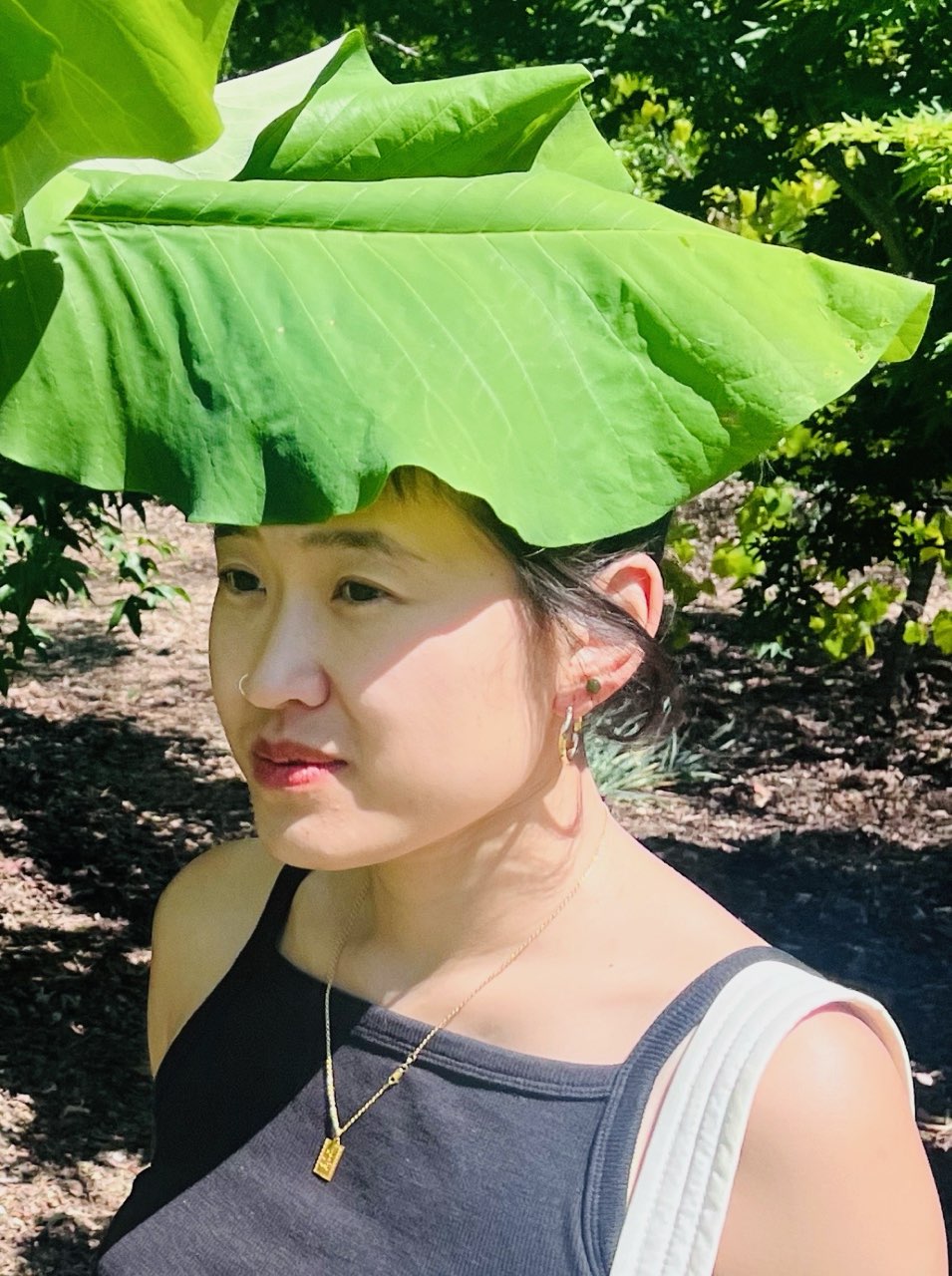
Something I cherish in my collaboration with Ryan and other friends is this expansive stance towards literary structure and versioning; the fact is, something can exist once in one form and then again in another. Like geologic matter, it can fuse and transmute and transform. Maybe years can pass between one version and the other. It feels like one big collage which is shifting and will grow into something else, or not.
In the early stages of working with my editor Corinne, I shared this entire body of work surrounding the book, which included textual and non-textual things like garments and projections and poured cement sculptures. We decided not to include extra images of those objects, because the book is its own self-contained instantiation within a larger world of questions.
In that sense, I find multiplicity, across objects, or maybe it's in the conversation between one object and another, maybe it's in the conversation between my work and another person's work. That relational, in-between space between artifacts feels potent to me. It can extend a singular point in time into pasts and futures.
In terms of what's missing, I’m not sure. Maybe a commitment to materiality——since the book is interested in long time scales, I've been thinking about artist's books which could be made of dirt or plant matter or soil that reintegrates with the earth. That feels like a rich and exciting space in the extended universe of the book.
JT: Also regarding the structure of the book, I noticed that there’s these layered relationships to naming——one of the first prompts in the collection says “Name every place that used to be an ocean” and beneath that, running as a sort of current, is a timeline of geologic epochs——a legible, named, scientific ribbon through time. Between and through those currents are poems, emerging. Were there particular feelings you wanted the book to house? Did anything emerge unplanned, unexpectedly? Did anything refuse to move or be named?
kw: I love the question of whether things refused to be moved or to be named. This makes me think of something Jennifer Elise Foerster said in an Ecopoetics workshop; I’ll try to paraphrase. She described the poem as kind of circling within a body of water, within a lake, trying to find the center, depth of meaning. It is always reaching, never quite finding the center.
And I feel like across modalities, I am reaching for a way to express shades of grief and love. It’s like a mathematics which in itself is a poem——a line which stretches but never arrives. The book’s score poems emerged through this reaching, because they are the most in touch with the body and its potential. They are short and instructive, often asking the reader to perform something impossible. They sit within the lineage of Oliveros, inviting reverberations from outside of the book. Writing these grounded me through the rest of the book, which felt heavy with research or a certain ambition of intellect.
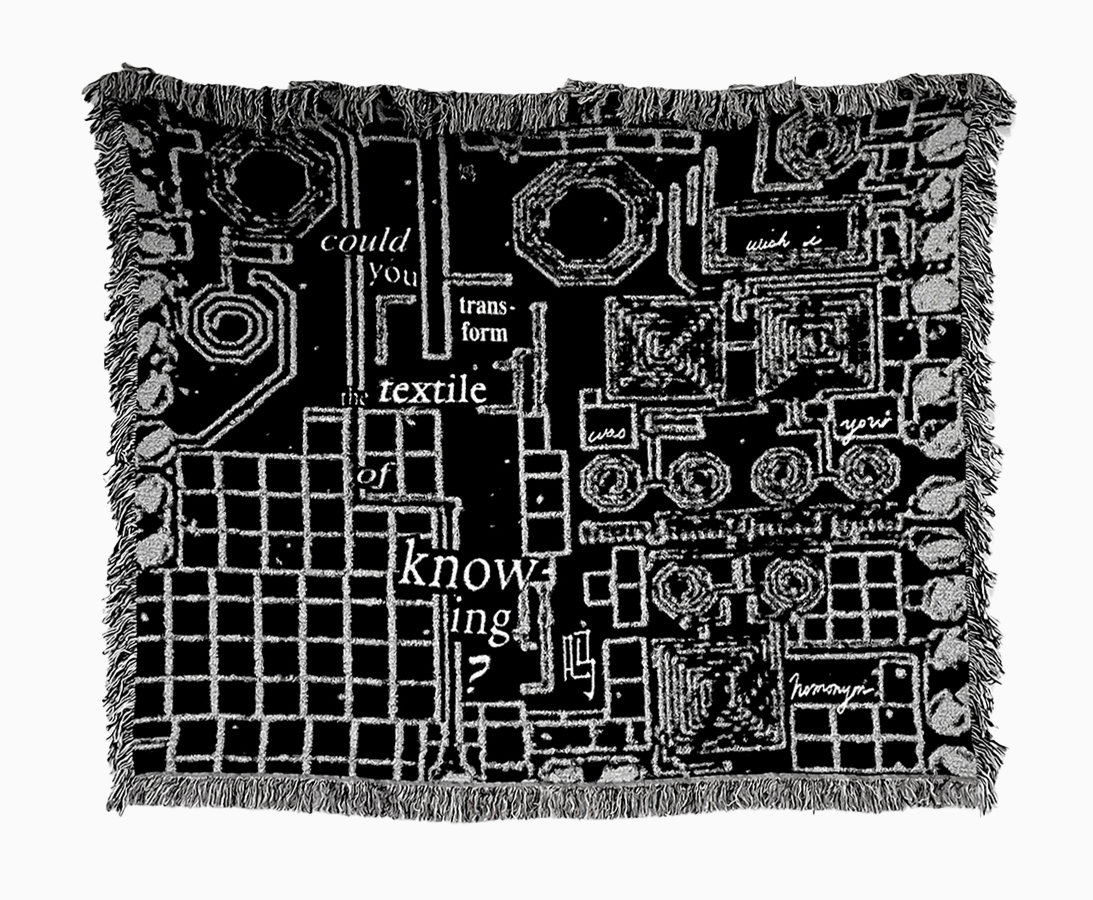
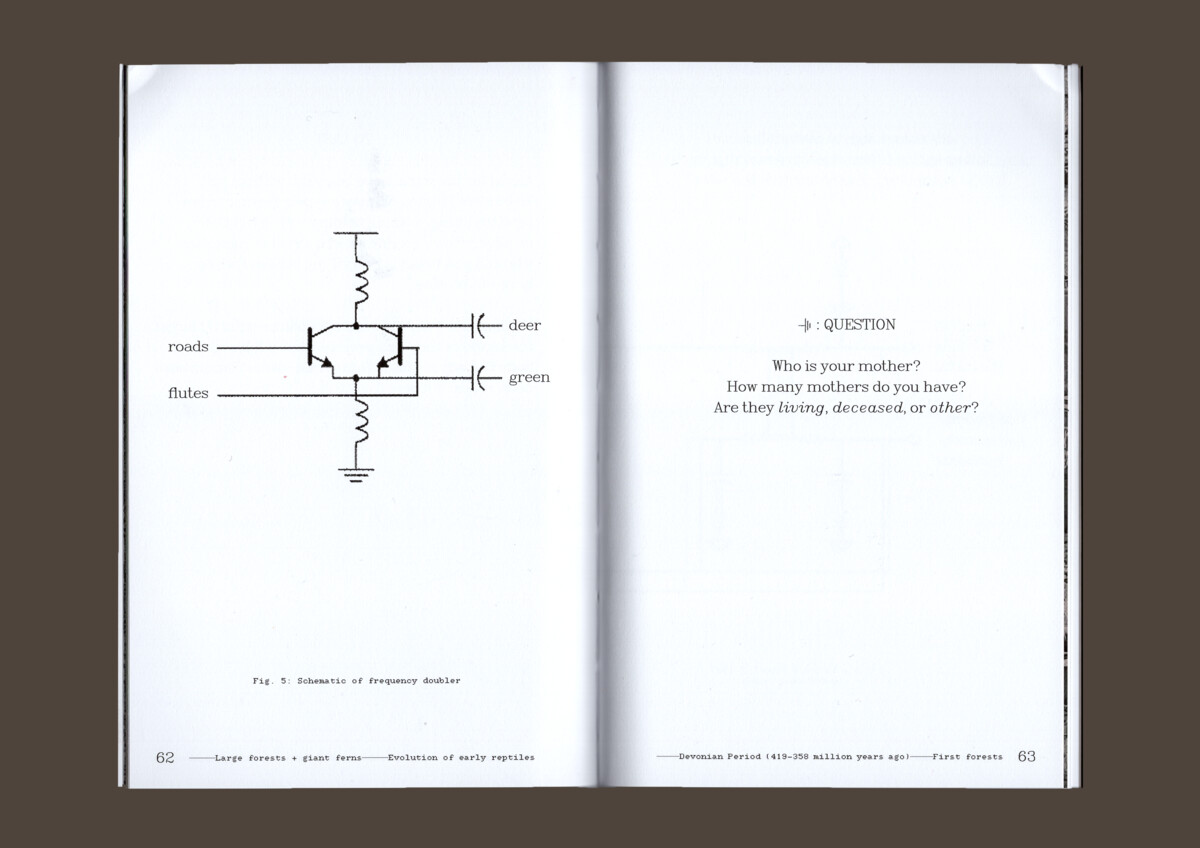
Another element of the book is the circuit poems, which were inspired by Yaxkin Melchy's circuit diagram poems, as well as the poet makalani bandele who shared with me his own conception of poem-as-circuit. This was also a way that I could spend time with my mother's archive, mining her works in specialty science journals. They create their own decidedly non-scientific logic, using spatial abstraction to tether personal language together.
The final poems I folded into the book were ones I had written fresh off a trip to Bisbee and Sahuarita, Arizona. The sense of place and the sense of geology was so intense and existential in those places. These were unplanned, and emerged after we began finalizing the manuscript. Being a body in space sometimes surprises me; language emerges mysteriously from the act of living, from being on specific land(s).
The “ma” as a textural component tries——and perhaps fails, in a productive way——to bridge dualities in those disrupted poems. There’s the global and personal, future and past, dead and alive, and so on. The latent space between dualities feels to me like the center of the lake——circling, never arriving. I’m not sure if the poem refuses, so much as is always a little bit out of reach.
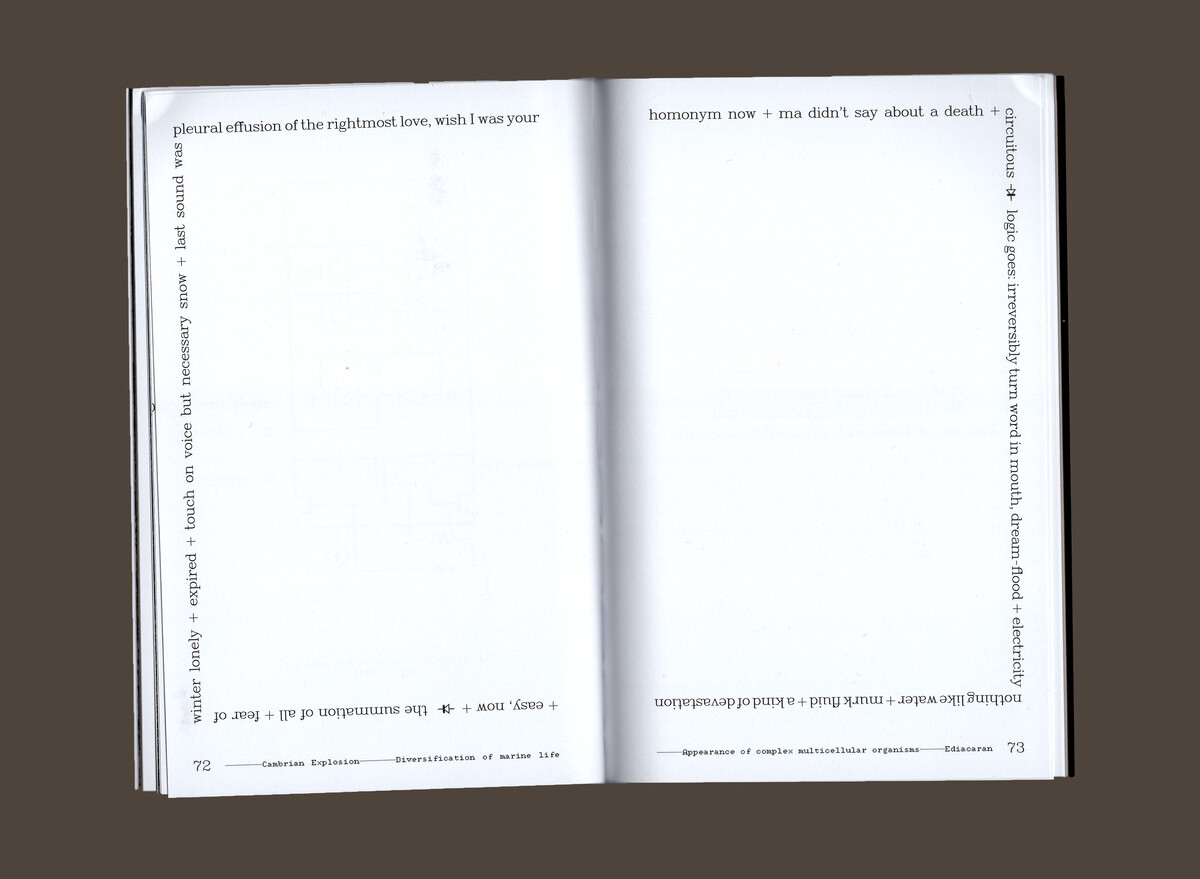
JT: I was so drawn to the textural quality of the poems, “Stone,” “Mainframes Doing a Million Maths Until You Find Gold, Just a Little Bit," and “No Object Found.” In each poem, “(ma)” or “妈” emerges, enjoins, and interrupts the letter “m,” though not always. There is both an organic quality to them but also an unnatural affect, almost like a glitch in ink and in the mind.
My reading was that grief could be both porous and also unyielding, that it could have a liquid but geologic, immovable quality to it. Could you talk a little bit about how those poems came to be? What are these poems asking or seeking to answer (if anything)?
kw: When I wrote these poems I had just started grad school; I was juggling caretaking and then turning that part of my body off at school to read poetic theory and research the Kennecott mining enterprise, or whatever. I was using my book-mind, my language-mind. I wasn’t allowing any of my ongoing, overflowing emotion to come to the surface. In a workshop, friends and peers told me that they couldn't really locate me in the poem——that I was holding the reader out at an arm's length.
As an experiment, I did a find and replace of the letter “m” in the poems and started from there, changing them all to the Chinese word for mother. Sort of as a cheeky way to be like, “Well, here's my grief——in its most direct form.” Using an artist’s tool kit to collage and redact the language, I could create little portals into my memory, and little portals into her memory, too. It was a gesture of translation and technology in both a lossy and literal sense.
In the days after my mother passed, I was kind of just saying that syllable, “ma,” and making the “m,” sound to myself over and over again when I was walking or doing the laundry or doing the dishes. I wanted to pass them through my body. They no longer had an addressee. I wanted to see where that vibration was reaching out to, to metabolize her absence through sound. I’m thinking too of CAConrad’s incredible project, Amanda Paradise, where they flood their body with sounds of extinction. “Find and replace” was a way to inject a singular atomic self-scale of grief into a broader landscape of global sadness and anger. Those computer actions are also funny to think about as verbs, as commands in this context.
I find this glitchiness you mention to be super generative. I mentioned “latency” earlier, and latent space feels like a rich and undefined area of material play. When is that threshold between me and not-me, between open and closed, or legible and illegible? In what ways can one tow the line?
JT: This collection also seems to be playing with a dialectic between technology and organicity——I’m thinking of the lines in your poem “City of Stairs,” where you write “So yes, I would say it’s fundamentally a technology of abstraction. I mean extraction. Language is. No, technology is.” Later, you write, “Try so that the poem isn’t mud.” There’s something interesting about how technology often seeks to name matter in order to exercise control or as a means of extraction (thinking of the extensive list of government mining data you list) versus what remains possible in that which cannot be named or codified easily into meaning.
What’s your relationship to failure in language? How important is failure in poetry? What are your preferred methods of technology?
kw: I’m thinking about the poet Imogen Smith’s new book, raw & zero; I saw her read online at The Poetry Project with my dear friend Basalt Hsu.
One of the lines from Smith’s eponymous poem declares, “Naming was the first surveillance.” I've been thinking about this line often. It summarizes so wholly and succinctly what I explore in much of my work——language as a technology of capture, and what we call “data” as extending old colonial exploits of taxonomy but now at incredible scale.
If we're talking surveillance and naming——could we unname things? Could it become a tactic of naming, become a tactic for evasion? The act of glitching is a kind of refusal to be seen and defined in totality, a noncompliance to certain codes of authority or efficiency. I think about Robin Wall Kimmerer’s “Grammar of Animacy,” and descriptions of life that circle how they are in the world in a verb-centric way, in a more embodied way, in ways which are dynamic and mutable. The Glissant epigraph speaks to this too. Sometimes within that contrast of taxonomy and ineffability exists a futility that excites me.
Another thing I want to say comparing the technological and organic is the relationship both have to obsolescence. In an organic sense, obsolescence is death—it is ending. At the same time, things which are ending are also often beginning; they decay and feed back into the planet, and some eventually become new life.
Technology at best tries to hold fast to metaphors of the organic world. Technology as industry narrativizes relationships to ideas of utopia or futurity, it promises infinite growth on a finite planet. We know that planned obsolescence is a thing, and that tech is constantly versioning itself, creating the storylines to render itself socially necessary.
There's also practical questions of technological loss; you know, net art and games of decades past become inaccessible all the time. Software and hardware will materially last for a very long time because they're made of metals and petroleum and such, but functionally, the cultural objects and texts within them will be much more ephemeral.
Still, some of the longest technology that we have for texts are books, oral traditions——petroglyphs, too. Language is a technology too, but is it organic as well? The dualities become fuzzy again. Language and image are certainly my preferred technologies, though they can take many forms and speeds.
JT: Lastly, I wanted to talk about the title, which has such a spectral, yet annunciatory quality to it. It opens the poem “Moon / Mom,” and in which you later write these beautiful, elegiac lines, “Leaning into an opacity that I love. I am not sure where the poem resides. Whether empty / electric.”
As you were putting this collection together, when did the name emerge? Where does the title of this collection reside in you?
kw: All my prospective titles were mined from the book draft itself at different stages. Early on, I was interested in a title combining stoniness and metastasis, but it didn't feel quite right. It felt too pathologized or clinical or also like close to a body that wasn't my own. Another title I thought about was For Let Earth, which I instead used for my Tilted House chapbook, which Cameron Lovejoy brought into the world with so much care.
I liked For Let Earth, because it contained programming syntax, but also transformed “let” into an adjective describing “earth,” a strange and sort of weary modifier. The programmatic name worked really well for the chapbook object, which almost entirely housed my diagrammatic poems.
As for She Will Last as Long as Stones; each key word is doing something relevant for the book’s world. For instance, it’s caused me to spend much more time with the verb, “to last.” I've definitely wondered, what does it mean for something to last? There is a sense of yearning or wishfulness, of wanting, which feels tender and almost impossible. There's a relationship to those questions of obsolescence that I brought up. It also nods something sequential——someone’s last and final breath, or their first.
“She” could be a mother, or a memory; it could be our planet, it could be my own body someday. Perhaps the “she” functions to separate the fleshy from the stony, the temporary from the seemingly eternal. And as far as “stone” goes——there’s something generalized and almost mythic about that material. Conveniently, the word “stone” sounds like “bone”; even without that association, “stone” delivers my mind to the graveyard and the crypt.
I’m not sure where the title resides in me, either! But like the word “ma,” it has entered and excited the body as air, as incantation. It became a little spell I was telling myself in moments when I wanted to talk to the dead. For all its declarative grammar, the title is not so much a prophecy, but a promise. A promise that I could make to myself that I will see her, you, or all of us again. A promise that ancestors will always be in touch.