

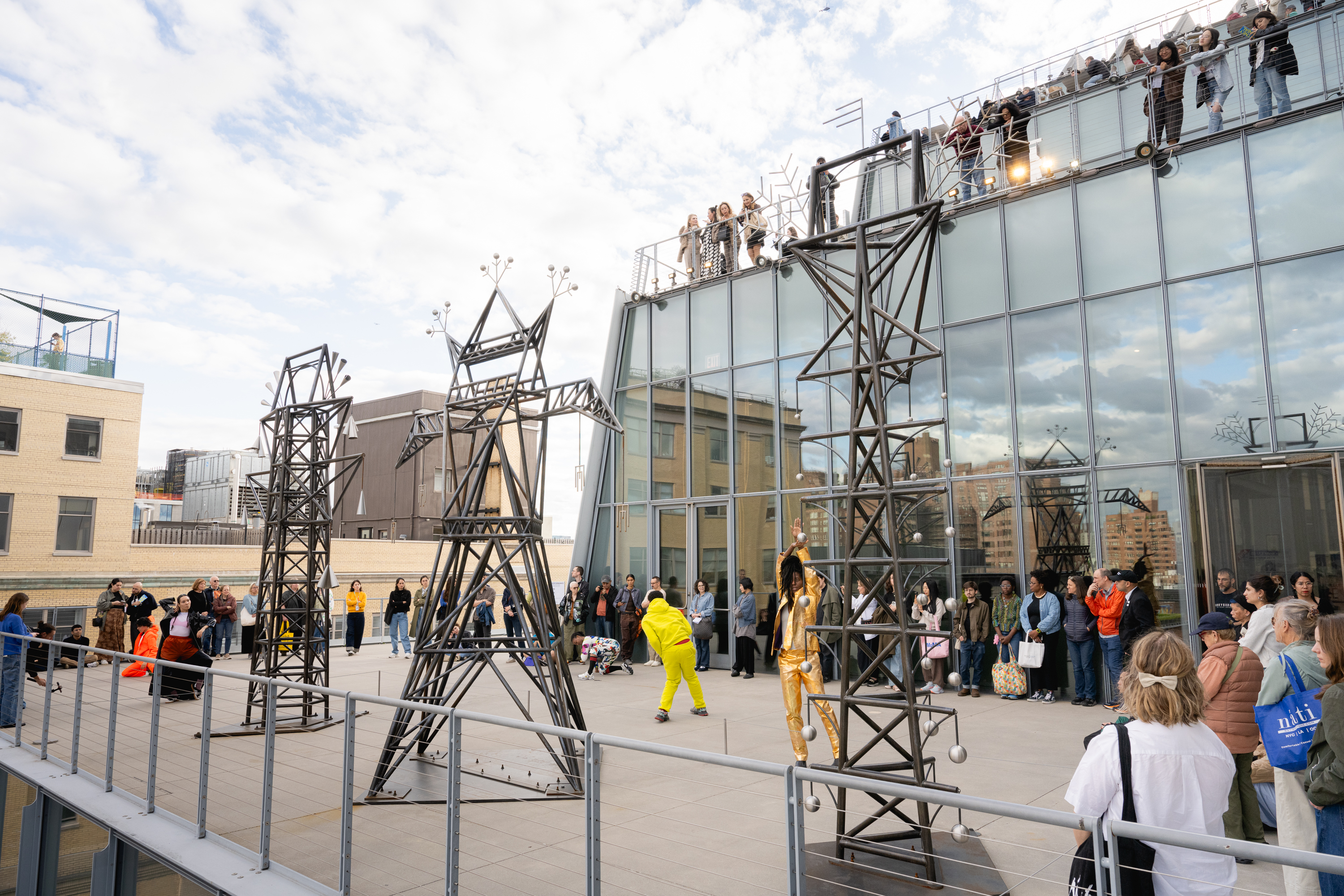
In Jonathan González's magic hour-golden time, commissioned for the 2026 Whitney Biennial, five performers traverse four levels of museum terraces as the sun slowly disappears. “Elevated somewhere between pedestrian life and the sun,” they explore the dynamics of seeing and being seen, inviting audiences to consider the nonlinear, layered processes through which our culturally-inscribed bodies perceive time. González is a choreographer, scholar, and writer whose interdisciplinary work explores embodiment, land, memory, and temporality, grounded in histories of Blackness. They are the author of Ways to Move: Black Insurgent Grammars (Ugly Duckling Presse, 2025), a 2025 Pew Fellow, and Assistant Professor in the Department of Dance at Hunter College (CUNY).
I spoke with them about time, interstitial spaces, and the performance of labor, leisure, and resistance.
***
Maia Sauer: Maybe we can start with the questions at the heart of magic hour-golden time, your work that was just performed at the Whitney Museum in May.
Jonathan González: Yeah, the work is a compounding of questions that move across different shapes and forms. What just occurred [in May] is one instance of a project that expands and contracts depending on the conditions and the invitation we’re trying to offer to the public. In this context, it was five collaborators. They each operated as an intermediary, or buffer zone, between the inside of the museum and the exterior world. That's how I conceptualized this project from the beginning and experienced it through my body first. I usually begin alone in the studio, metabolizing the work and churning through its conceptual and choreographic scaffolding. I also draft through images, film, and movement. I play with text to try to understand across various semiotics and devices of communication what the connecting or not-connecting threads are. What are the attractions drawing me toward something?
I wanted to explore being an intermediary between inside and exterior worlds: inside the Whitney Museum and the exterior world of New York City——the skyline; all the things that this land has been before it's been named what it's been named; the things that cannot be named in the archive of what it's been named; and the very personal attachments I have as somebody who went through my formative teenagehood and sexual, gendered, racialized formation, born and raised, here. The West Side Piers have been important to me historically and personally, and that significance continues through the work David Hammons made there. So, for me, time is always geographically polyvocal.
When I'm feeling through the instrument of soma, through kineticism, through the body, sometimes I’m going through rational thought, but sometimes what’s emerging is through other forms of thinking, which may not actually process into a sense of linear time. What I'm trying to bring up, cultivate, dredge up, and recall with other people are these other modalities of feeling and experiencing time. How they collide against each other matters. It's about the encounter between a person moving through that inside-museum-time and arriving upon these particular people, and what these collisions of time do.
MS: ——like treating the Whitney Museum as a body itself: a kind of locus that concentrates and collides with various bodies experiencing layers of their own time. How would you describe your personal sense of time during your choreographic process?
JG: It's hard to tell anymore if there are indexing moments. There was a time where that felt easier. Maybe that's part of your question. The work is still being worked out, and you're catching me in the midst of that.
There are some elements of the work that are very important to me now that weren't there even just a year or two years ago. One of them is this idea the performers and I have been riffing on: borrowing scenery, or shakkei. This is something I learned while I was in Japan, in the gardens in Kyoto. It’s a tradition that has long existed there, where a gardener or farmer might mimic something they see in the landscape and produce it at a smaller scale in their own land. There's a common example of a mountain that could be produced in a smaller-scale garden. On one level, I was told, this is a kind of mimesis. Then at a second stage, it's actually closer to the thing that I'm trying to break open [in magic hour-golden time]: a kind of phenomenological response. I'm trying to translate and transpose the feeling of seeing that mountain into something else, which is maybe akin to music. The mountain might become a small stream in a farmer’s garden because of what the mountain made them feel.
This feels very hot at the moment for me, elementally, primally, conceptually, intellectually, creatively, socially——these vectors of thinking about what the body does as a tuning instrument to the written word and to the world. And the related questions: what is a body? What is in a body? How have environmental forces, bodies, the air, the space between us, been given a particular genre, which they may have not agreed to?
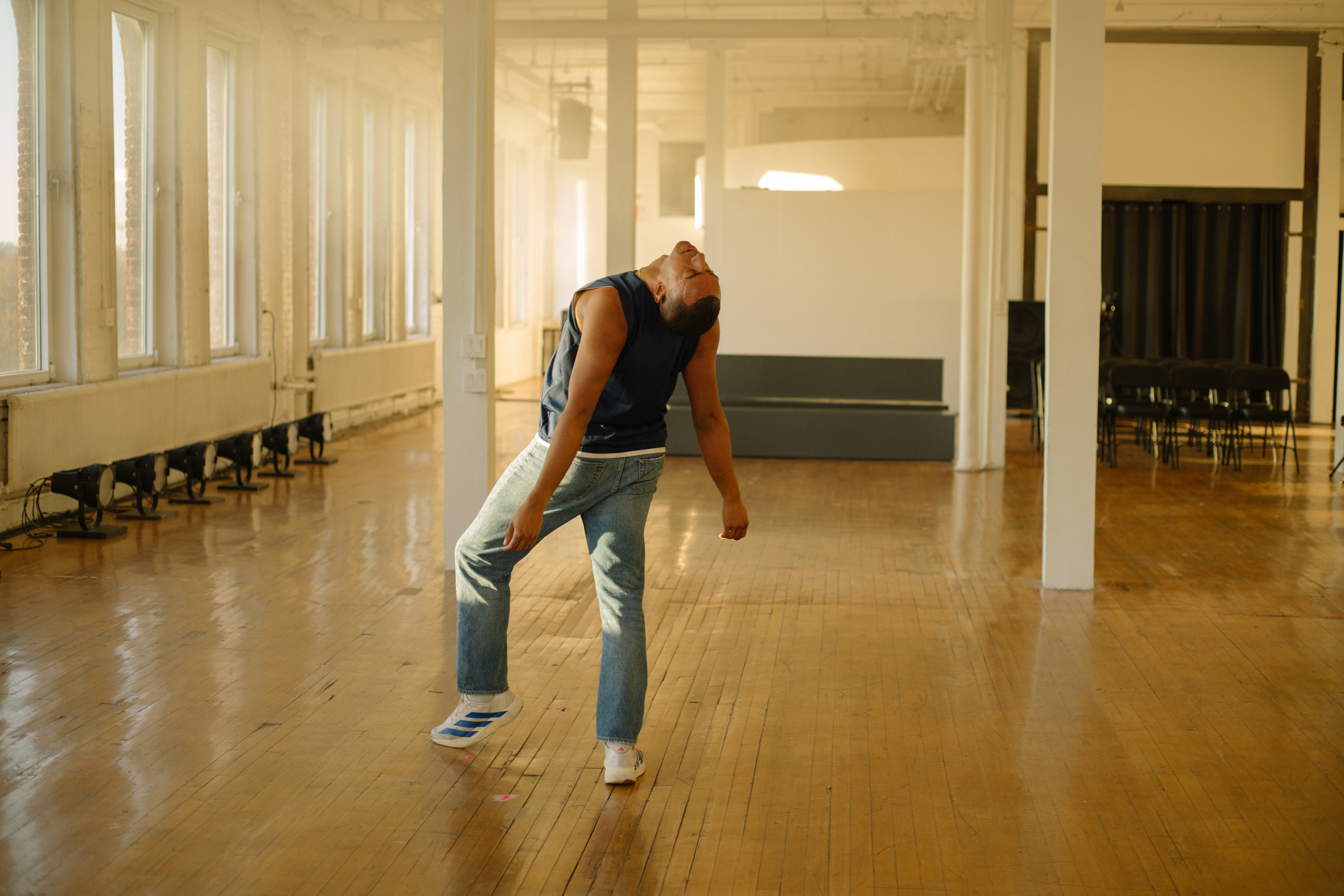
MS: What you're describing sounds like a more active process of inquiry with the bodies that surround us.
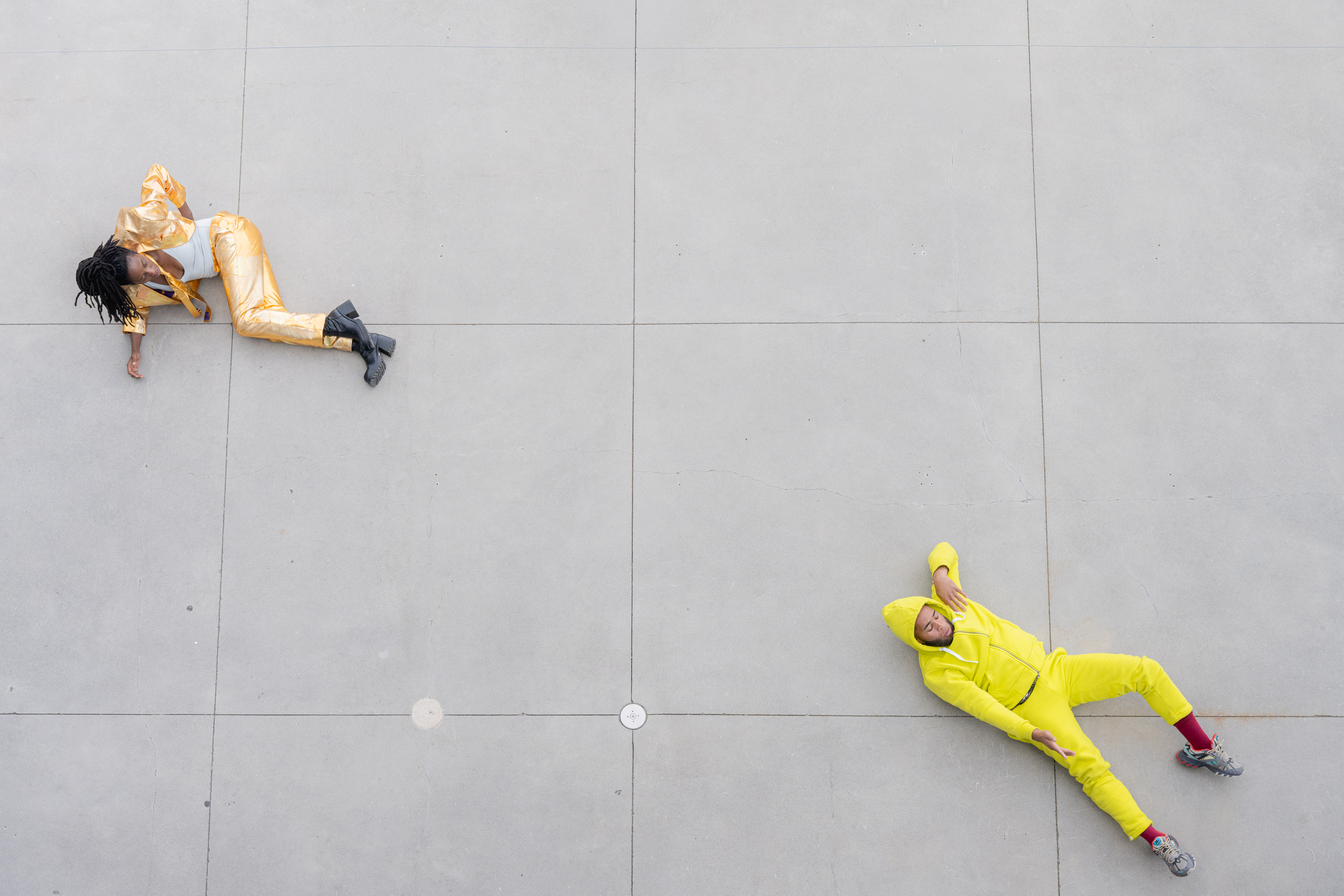
JG: Yes. There's also a new final section in the piece, which we call the Endless Bow. It’s the final 60 minutes of the work, facing the waterfront, the Hudson River, David Hammons, the Gordon Matta-Clark site, the Piers, and the sun. The performers look directly at the sun as it sets and disappears, and they're in this choreography of the action at the top of a bow. Not the bow itself, but the top of the bow. They hold that action together through pressing the back of their hands against each other. You're also experiencing that as an audience member. The museum is closed at that point from across the street, so the West Side Highway is between you. It's blasting with cars speeding and honking. There's bicyclists, there's runners, there's tourists, and then there's you and all of that between. The performers are six floors up on a terrace that's not accessible to the public, facing the world. They move within this tension, which is endurance-driven. But by that point it’s become a trance. They’ve been performing for two hours, so they’re inhabiting a different psychic state. They're elevated somewhere between pedestrian life and the sun.
MS: I'm noticing the homonym of bow, like the bow of a boat. That image has a holding-together feeling to me——a driving attention.
JG: And what's interesting is the bystander-effect that happens with that attention. People who are going about their day, who’ve maybe never engaged with the Whitney, get the opportunity to look up. They have many different responses, of course, but they're taken. It continues this question of looking at what makes up our own gardens and wondering how we’re being seen. The protagonists now become New York City's walking culture, driving culture, biking culture. The performers operate as a kind of vanishing point——a real backdrop.
MS: Could you walk through the rest of the structure of magic hour-golden time?
JG: There are three sections, each an hour in length. What happens over those 60 minutes in each is a development. It doesn't stay static. It's highly structured, improvisatory, and specific. In the first section, A, we begin with this practice of shakkei, or borrowing scenery. I've been doing this practice of tracing——just simply tracing out the architecture of something, like my walls. It's very literal, and we do it as a warm-up, typically to arrive and situate us in relation to our surroundings in a practical way. It wakes up that energy cognitively, somatically, and attentively.
The work begins from a position where all performers are leaning against the museum. They enter and begin to trace the horizon of what they see. They're not paying attention to audience members now, though the audience does surround them from every floor. You can see from within the museum on the same terrace, but also from terraces four floors above. At that point, you can also experience this work from below.
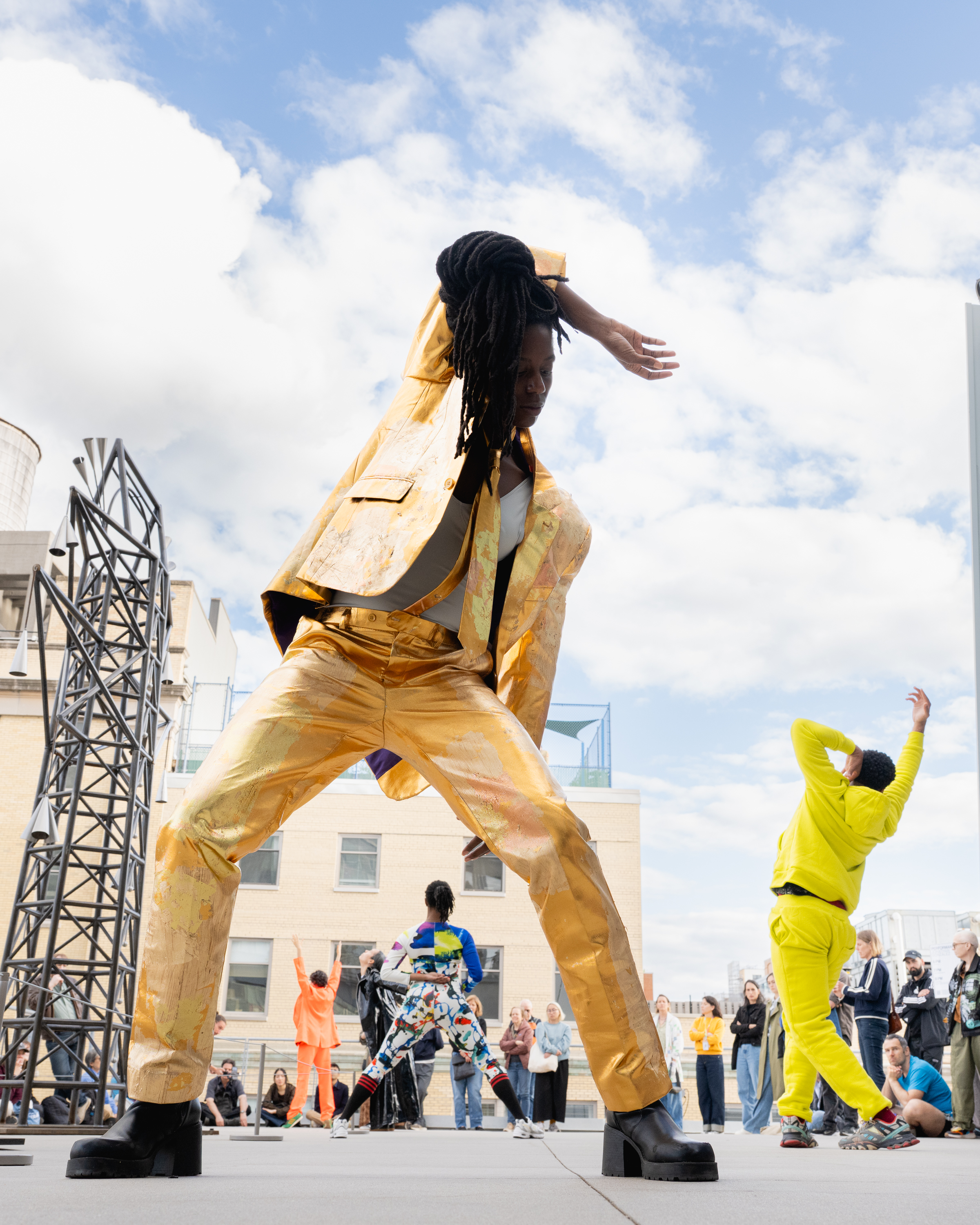
To speak to the theater, there are various costumes. Each is quite distinct in its aesthetic and texture, but they all bring a fluorescence and vibrance. The costume designer, Liz Prince, and I practiced watching the work from the High Line, from down the block, and from three blocks away, so we could really understand what was effective. We went through many costumes, because we had been rehearsing the work since January, every Tuesday, sometimes in the snow and rain. We were trying to understand how to create a visually effective palette across all those different conditions. The costumes feel quite theatrical to me, because I often work with more ambient tonalities.
Section B moves across all the terraces. There are four floors in total. It refers to a vocabulary I call Archive Body: the request for the dancers to dance with every dance they've ever danced. It's like a procedure of both what you can do and what you fabulate, or invent, because in the process of trying to be with every movement your body has done, there’s slippage and there's gravity and there's imaginative desire. All that plays into it. It's a solo practice, but performers are also positioned architecturally in equidistant structures across the terraces, so they can see each other. The second layer to this is a kind of game of correspondence, where they take gestures from each other while performing Archive Body, so this transmission happens, both in terms of their own notions of their dancing life, and adding gesture from what they see from their collaborators and audience. So this is the one time when the work opens up for interactivity, and a lot of the audience participated. Audiences taught me that at the museum, they also want to perform, though they're usually not given that opportunity. People joined, tried to lead, and created their own clusters of this game on different terraces, which was exciting and bizarre. I feel like people also come to the museum and want to have a certain experience. The museum still represents something in the psyche of a visitor.
Then, the final section, as I mentioned, is the Endless Bow.
MS: In your book, Ways to Move: Black Insurgent Grammars, you trace the resistant language of the Black body in motion, particularly how it operates in the interstices of white colonial culture. I’m curious how you see these interstices relating to magic hour-golden time.
JG: Yeah, the interstitial spaces are rife here, and my practice feels extremely iterative. There are more variables around it now, with more work and more public reception, but yeah, I believe that’s actually much of the thing that brings me to shakkei in this piece.
I like Joan Kee's research a lot on Afro-Asian solidarities. I think that research is really exciting in terms of how we contextualize certain methodologies that have been shared across spaces geographically and historically. In that research, I feel like there are a lot of ways that people have been working with interstices between land and body. But even that contains so many variations, in terms of what a land and what a body become, and can become.
With regard to Ways to Move, I'm situated in the legacy of that question of where the body gets constructed. What is its alignment in relation to the earth? What is the earth, and how do these formations start in a very crude sense and move all the way up to something that might seem, like, quantum? Where do we understand the philosophical constructions that create the supposed divisions between them?
There are a lot of conceptual artists and Black Studies scholars who are working in these ways all the time, but I guess as I’m working from dance, performance, and image-making through dance, I’m trying to really center form, and form arrives on the heels of Blackness and the performing body in the visual field in such a way that disturbs me and prompts me to ask other questions. What is a Black interior psychic life? And what is a Black exterior interpolation and where do these things meet? Where do they not? What is the kind of libidinal economy that surrounds the experience of Black performance in the geographies where work is being shared? What is the experience of watching Black dance and Black bodies, performance, and embodiment? Where does that somatic register emerge? Can it emerge? Can the interior life be held? Can it be seen?
These are questions that are not particularly new. I think of Tina Post's work, which has been important for me, around Black Deadpan. Or Kevin Quashie’s, around Black Quietude. Inside a Black community, we know these things exist, but it's in the visual field of the everyday. It’s what Torkwase Dyson calls the abstraction of racial terror. It's the everyday terror that actually produces the inability for these other modalities and punctualities of Black embodiment in public life. And they're also operating at literary registers and architectural registers.
I think I'm really trying to ground: what is the relationship between the Black mundane, the construction of the Black body, Black land, and the philosophical notion of rationality? How do these things talk to each other? Choreography is situated in the history of law and the idea of space and discipline, like the severe disciplining of the body’s 90 degree angle over the earth as a kind of settler orientation. Where do we get to experiment with proneness, or with other frequencies and rates of movement? I’m also interested in trance and a collapsing of the self into a we, or that attempt to follow and ride what I've experienced in ritual space in the Caribbean, where I've done my research and where my family is from. I see the duration of the ritual site, I see the commitment, I see the collective form that surrounds that performance zone. That’s a place where people will be for multiple hours and will let the sun fade and come back. There will be exchange and learning. And that isn't a site of labor, that's a site of something else.
MS: Could you speak more to that distinction between the performance of labor versus leisure? The word rest is complicated, but I’d love to hear where you situate yourself and your work in relation to that idea.
JG: It's funny. I was just listening to a conversation on leisure. It was with Catherine Liu, who has a new book out. I do think I’m straddling a bind there, you know? There are artists who are engaging rest in a more direct way in the setting of the work. My work actually requires a kind of arrival to even begin that might be activating for that question. To go back to the idea of quietude, though, rest emerges through creating the conditions for a Black performer to simply be in the room.
I’m trying to lower the frequency——to lower the output level and move away from archetypal languages of perpetual motion and virtuosity——or proving a particular kind of ability. I’m also working against the inherent charismatic nature of the performer and questioning these platonic ideals of art as they pertain to form and symmetry. I'm reaching for the abstraction of those terms for Black performance.
That's a hard part, much of the time, for performers who begin to work with me who are coming from commercial dance forms where they've had to deal with reception and framing in a disciplined format, because I'm trying to reach toward the question of who are you and what can you say right now? And if you don't have anything to say, take a break. I say that all the time. [magic hour-golden time] is three hours, but performers can go to the green room and take breaks. They didn't end up doing those things, but they knew they could.
Another factor that relates to restfulness, is being suspended above the audience and being able to ride the performance in a psychic space where performers feel they have autonomy to a certain degree. I'm a director, but the performers understand the conditions, the breaks, and the musicality and dramaturgy of the work.. They know when it's working and when it's not, and when to step out. They trust one another to hold each other in that process.
I feel like my casts are always very bonded, and we speak a lot about what feels leisurely and what feels laborious. I'm trying to break the evening-length frame, along with notions of temporality tied to performance, so I know I need to create conditions where we can talk about equitable work, conceptual fatigue, all the things that emerge in durational work, and the racialized logic of it. We're thinking aloud all the time about the feeling-space that's guiding the initiation to even perform, and what to do when that feeling begins to rupture. Or when there is an experience with an audience member or the climate pivots for some reason and a performer needs to step away. It’s about being communicative inside the work, not letting the work be a theatrical framework where we don't reveal failure. We talk to each other. Many times, I interrupted the work to ask audience members to relocate, because there was a desire to get very close to the work, and I felt like, okay, the performers are being compromised. We're very engaged in trying to understand where the extractive force of the work begins to take hold, where labor is, where leisure is, where rest is, and where there’s something more sacred and divine.
MS: How do you connect with your collaborators and begin to build that trust?
JG: AJ Wilmore, Ananda González, India González, Kingsley Ibeneche, and Marguerite Hemmings are the five performers I'm speaking about here in magic hour-golden time, but there have also been Wayne Arthur, Chazz Giovanni Bruce, Lysis, Rena Anakwe, Kris Lee, Katrina Reid. I work with a sound team that includes Alexis De La Rosa and GENG PTP. I work closely with producers Greta Hartenstein and Nora Chellew, and filmmaker Rudy Gerson. I have kind of a core team of people who are working in different amalgamations across sometimes more than a decade. I've had a life as a performer and have worked with other artists as a collaborator, so some of these relationships have emerged through that. Some are deep best friends, and we've grown together through life. Some are people I've had the opportunity to meet through mentorship, and others are chosen family.
I take a long time to build a collaborative team. I understand how difficult it is, and it feels essential to figure out that matrix together. So it’s been a long process, but this is a very solid team, and I’m grateful.
***
magic hour-golden time
Performed by AJ Wilmore, India Lena González, Ananda Naima González, Marguerite Hemmings, and Kingsley Ibeneche
Costumes by Liz Prince
Produced by Greta Hartenstein
Commissioned by the Whitney Museum of American Art for the 2026 Whitney Biennial, magic hour–golden time is co-presented and supported by Frieze.