
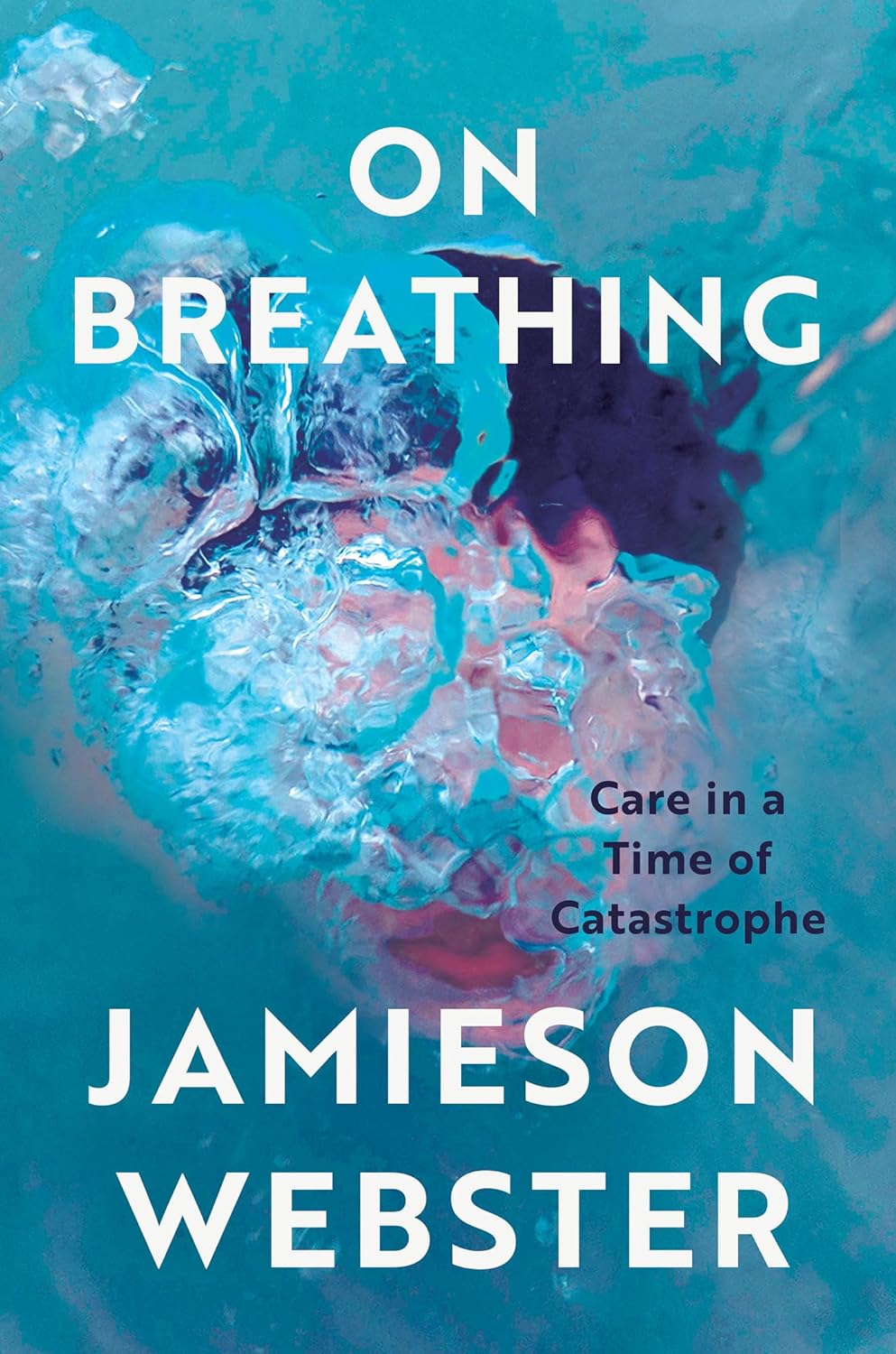
“From the moment of birth, breathing is something we must do for as long as we are alive,” Jamieson Webster writes in On Breathing: Care in a Time of Catastrophe (Catapult, 2025), “yet for the most part we don’t pay it much notice. If one of the main claims of psychoanalysis is that we forget sexuality, I think we must add breathing to our list of amnesias.”
In her most recent book, Webster considers breath as a forgotten condition for connection, as well as isolation. Breathing is the first “sign of our separation from the bodies of our mothers,” she writes, but also, eventually, a way to “speak to these relations of care.”
Webster is a psychoanalyst, teacher, CULTURED Magazine columnist, and the author of Disorganization & Sex (Divided Publishing, 2023), Conversion Disorder: Listening to the Body in Psychoanalysis (Columbia, 2018), and, with Simon Critchley, Stay, Illusion!: The Hamlet Doctrine (Vintage Random House, 2013).
We spoke with Webster about breath, female pain, the wellness industry, and dissonance.
***
Maia Sauer: On Breathing covers a lot of ground, both in its contextual grounding in psychoanalysis and in regard to your personal life. How and why did this book come about in 2025, at this particular moment?
Jamieson Webster: The book comes from what I wrote during the pandemic when I was working in palliative care. I was pregnant with my daughter, and then I had an infant and was thinking a lot about her. Then, my father died. So, there were a lot of life and death and breath questions hanging around. I also started to have the feeling in my work with patients that we were still laboring under what had happened, even though we’d gone back to normal. Something was off. There was a terrible feeling of no-going-back, and yet, at the same time, no understanding of where we had gotten.
In part, I wanted to push against the wellness industry. It's all confused in weird therapy speak on the internet. So I saw [the book] as a way of maneuvering around that. Everyone was like, just breathe, and I was like, that's not happening.
I also did work at 9/11, and I did a news program in 2021 on its 20-year anniversary. The piece was about 9/11 and COVID, and I realized I’d worked at both. I looked at pictures of how we had to wear masks because of the asbestos and the smoke [at 9/11.] It was really uncanny. I was just beginning grad school then, and I ended up making my way down there as a volunteer. I have a long career of working in strange places. I wanted to go back and work on it as a book. I wrote it really fast.
Olivia Q. Pintair: You write about society's impulse to avoid and/or fetishize female pain, partially through the lenses of the siren, whose songs of grief can sink ships and strip men of their power to kill people, and the ololyga——a shriek that women made in ancient Greek rituals. Referencing Luce Irigaray's work, you’ve said: "the forgetting of air is deeply tied to an erasure of the feminine." I’d love to hear more of your thoughts on womanhood and sound. Are there current iterations of the ololyga?
JW: Some of that is a repetition from my first book, in a section about Nicole Loraux. She was part of a French tradition questioning ancient Greek life, mythology, and the birth of democracy. She traces the birth of democracy in a way that pulls the rug out from under our glorification of it——like, German philosophy-style——to point out that obviously there were women and slaves as democracy was born who were not beneficiaries of that democracy. And even more, there's something important that’s been built by the exclusion of women's pain, grief, and affective lives. The bodies of women are usurped in the interest of male heroes, who are cut by swords and who bleed glorious deaths given to the nation state. But this seems to obscure the fact that women's deaths are often hanging, or noose deaths, meaning their bodies are closing up. Any openness of their bodies must be in the service of the city.
This has been really important for my work for a long time, because psychoanalysis is then born from the giving-back to the woman both the openness of her body and the experience of psychic suffering, and the way those come together in the question of hysteria at the turn of the century. I don't think that we're anywhere very new. Not to undermine the advances of feminism by any stretch of the imagination——we might pay tribute through discourse and perhaps financially to the necessity to make women equal to men—but, in terms of what the world can tolerate in relation to women, it's still, I think, very minimal.
In particular, we see this in the medical world. [Women are often] in the position where their speech and language and words, sounds, and grief are intolerable. What I've always seen in hospitals is the way this is pushed down and ignored. There are these more sensational podcasts where the nurse has stolen the ketamine from the bags of fluids, and the women are like, Ow, and the doctors are like, but you're sedated! What's the problem? You know, that's the sensational version, but I think this happens across the board.
OQP: I’ve read that women who report pain to doctors are more likely to be given sedatives than pain medication in comparison to men.
JW: The majority of patients that I treat just heap pharmacological medications on women at the first sign of distress. It's catastrophic at certain points, because I get young teenage girls ten years later, and they've been on six medications, and no one has spoken to them. They just tried to make them shut up by sedating them.
MS: I’m curious about sound itself and what the opposite of that “shutting-up” would be. I'm reflecting on an experience you co-hosted at Pioneer Works last year alongside Andros Zins Brown's Chaos Opera. That was a particular, choreographed example of what sonic dissonance could feel like, in a generative way.
JW: I love the Chaos Opera and the idea of singing together without singing the same song as a deep practice of listening. It's this conquering of your inhibitions around your voice, which is so important and hard.
My friend Freya Powell has something called the Dissonance Chorus. She did a piece during COVID on Elektra, who refuses to stop mourning. They're amazing, these six singers, whose voices go together and come apart and scream and cry and choke and breathe. And I invited Eliza Douglas, the performance artist and painter, to do something with me for this breath reading event. She sang Kate Bush's song, “Breathing,” but she took it into her Eliza style, and she had all these performers around her vaping. The song is incredible. There's an atomic bomb that's gone off, and a child is breathing in utero, breathing in the mother's nicotine, and then breathing in the atomic gas. At the very end, it's like: what are we going to do? What are we going to breathe? On one hand, it was a lullaby. You can't stop hearing Eliza's voice and you can't even hear the Kate Bush version anymore. It's both soothing and a warning. It traverses that edge. It was like a miracle.
OQP: That's something we've talked about a lot in the context of lullabies: this dynamic edge of both soothing and warning. An eeriness. To engage with that is comforting, by acknowledging what's real already.
JW: Like “Ring Around The Rosies.”
OQP: Totally. About a year ago I became entranced by the book In Praise of Risk by Anne Dufourmantelle, which I know you’ve written about. I wanted to ask whether you see a relationship between Dufourmantelle’s definition of risking one’s life (as “first, perhaps, not dying,”) and breathing.
JW: Yeah. I knew Anne Dufourmantelle's work before the event that has mythologized her, which is that she died saving a child. Her work is very important. She wrote a book on hospitality and one on risk, and there's something about the position she takes up in relation to psychoanalysis, which I think puts it in a place of unmastery. She's rare amongst Lacanians, who get really annoying and think that they're like the masters of the earth with their Lacanianism. She goes against that unfortunate strand.
It's tough, because it's not as if to pursue unmastery, one doesn't have to try to master a whole number of things. Pushing against a limit——obviously, you're pursuing something like mastery. You're gonna have to hit the wall, right? And I think that's the case in analysis for patients. This is a bit of the trick of it, but we invite you to come try to master speaking spontaneously, encountering your history, mastering sexuality. All that's impossible, you know, and you can be like, Okay, well, fuck it. I'm not gonna do it, because it's impossible. But that's not the point. The point is that you try, and you see what happens. And both of you are in it, so I think there's a feeling of real risk there——of hosting it, inviting it, and courting it.
OQP: I love that. It reminds me of the trickster stories in myth. There's this character who welcomes you into a kind of liminal place, and then it’s like, what's gonna happen? Sometimes there’s a promise that something transformational will happen, but sometimes it's just a matter of stepping into that dark.
JW: Yeah. The breathing story that I wanted to tell has a lot of these elements in it. For one, this question of where's breathing going is really unknown. We've evolved from the sea onto the land, and breathing is this weak point that carries history in it. With questions of climate change and pollution, what's going to have to adapt with our breathing? We're all mouth breathers now. Like, none of us can breathe anymore. We're all going to yoga, trying to figure out how to breathe. It’s this pathetic, weird stage we're at as human beings, and there’s real confusion around it.
It’s not like we're ever going to get to a natural “authenticity” [in breathing] which I think is unfortunately the promise a lot of the time with the wellness industry. There are also these examples of all these people who go over the edge, so to speak, with breathing. Whether it's deep sea divers who die like 50% of the time, or the amazing experiments of curing oneself of really strange ailments through wild athleticism of breath. We can't really keep these stories as transmitted knowledge, because it's something that has to be developed in a really wild, individual way. There was a woman who straightened her really severe scoliosis through breath. There was this guy who cured emphysema, which is still considered an incurable disease.
So, the story of breath is wild. And I see this invitation to push it to the limits, and to see how this took place in psychoanalysis. All these guys wanted to free us from anxiety, and they were trying to dig in, like: is it the mother? Was it birth? What was it that made us anxious and how can we undo it? I think Freud's anger at his followers was that you can't undo the problem of anxiety. The problem of anxiety has to move into the future. It can't move backward.
MS: What about lullabies? Do they come up in your work or in your personal life?
JW: There's a lot of the lullaby in the “Goodnight Moon” chapter of On Breathing, which is about reading books to children. I think that chapter is the closest I would get to a promise, in the form of the lullaby, that's repeated to the child. You have to provide the child with a minimal idea of consistency. You don't want to promise consistency, at least from a psychoanalytic perspective, because nothing's consistent or totalized. But you have to assure them there's going to be a tomorrow, so they can go to sleep.
The next chapter was about my relationship to violence in language, and what you can't get away from in language, and what’s psychotic-making about language. There's no soothing——no lullaby——for a psychotic person. The reason to push that far into what's terrible about voices is so that you also remember the power of a voice to do something else, or the possibility of continuing to develop a voice that speaks through more than just that violence and crack. I think you need to have both experiences.
There was a moment in my own personal analysis, when I understood that somewhere in my mind was my mother's voice. She was very much a mother that I didn't know, because I was abandoned. But in some early VHS tape videos of me as a baby, she was there. I knew her voice, you know? I knew that it was in there. I've always wanted the music I listen to to be a woman or a man who sings like a woman. I only wanted a falsetto male voice. I'm just searching for her voice. So I think the lullaby is really important. There's something about all of us finding it or re-evoking it or making it part of our lives.
OQP: The end of the book speaks to what language can't say, and that silence of breath——abyss of air——that remains. There’s this call to action you invoke, which is: say anything. Say everything you can say. What are the stakes of trying to say anything or everything that one can right now?
JW: I never thought I would live through a moment like this. Across the board, I think the problem we have, whether it's this repressive regime that also pretends to be the disinhibitor of speech, or whether it’s those who, in the interest of more equality and democracy, have a voice too injurious and self righteous, it seems to me, we're talking about voice.
To “say everything that you can say” in the privacy and confines of psychoanalysis, is so you can understand your limits and your own violence and all the things that you’ve experienced, so that maybe you can understand better how to intervene in a world that still can't get this right. How do we speak to each other in a way that is nonviolent?
Lacan, in his late work, which is so unbelievably hard and obscure, says that the fact of speaking gets forgotten behind what is said and what is understood. He kept saying this at the end of his life. It's the idea that everything going in the direction of understanding and making the other understand you, forgets that we're speaking. That's all we're doing. We're speaking——ultimately, making sounds. We want to institutionalize things and truthify things, and make things right and hold ourselves up with just sounds, which is a huge part of the trouble. He says to analysts: you guys forgot that Freud was just this guy who spoke and invited people to speak. Everything became this heavy-handed: which one of us is right about Freud? Lacan refused to write very much, and what he did write was disturbingly opaque. But what we have is transcripts and audio recordings of him teaching——which is also just speaking. I think he was reminding us himself that he was just a guy who wore himself down making sounds his whole life. In psychoanalysis, if you try so hard to plant these flags and make meaning and say what's true and what's wrong, there's a lot of having to let go of that and what that then makes possible. I think sound plays a big part in that.
MS: Which feels a lot like falling asleep. What’s happening now, versus what, maybe tomorrow, I will understand through my linguistic analysis of it.
JW: Yes, being able to kick the can down the road. You can wait and opt for silence.
OQP: I'm trying to write right now, and I'm feeling very struck by how physical an act it is. What's your relationship with sound while writing? How does it feel like it compares, as a medium, with speaking?
JW: I'm always struck by the difference between writing and speaking. I hope I am a clear teacher, but I don't ever write the way that I teach. I think it's because in writing, I care more about the poetics, and I'm always trying to build my way there, where I can get out from under the ideas. I like ideas, too, but I'm not someone who makes arguments, actually. I sort of fake making an argument in order to write.
Sometimes there's a moment when it dissolves into pure writing. I'm so happy at that moment. It's such a weird task——so unbelievably different from my pedagogical responsibility. But I have a lot of fun teaching and seeing what spontaneously happens in the room. I sometimes wish that I could devote my life more to that.